
ResidentialChris ThomsonTue 10 Mar 26
Setback for Harbour Housing at WA’s Booming Albany

An Adelaide wool entrepreneur is disappointed despite managing to shear a third off a mandated harbour setback for his eight-storey mixed-use renewal project in the Western Australian south coast boomtown of Albany.
Mark Dyson bought the 163.8ha woolstores site on the northern bank of Princess Royal Harbour 25 years ago after the stores closed in the early 1990s when riding on the sheep’s back was no longer an option for the Australian economy.
In 2024, a push by City of Albany planners to clip the maximum eight levels Dyson proposed for the site to six storeys was narrowly rejected after extensive debate by the municipality’s mayor and councillors.
But the elected members agreed that the city advise the WA Planning Commission to dismiss Dyson’s proposed 10m setback from the harbour in favour of a 20m setback. The city also recommended the commission require a 10m stretch of open space beside the buffer, meaning no buildings could be erected within 30m of the scenic harbour.
This month, Dyson appeared at a meeting of the commission’s statutory planning committee to request a 10m public foreshore reserve only.
Dyson’s planning consultant Greg Rowe told the committee the 20m setback was “arbitrary”.
“There is no scientific basis that has been presented to us,” he said. “We say it is simply an opportunistic approach to this matter.
“We say that a better outcome can be achieved by keeping this land in private ownership; this will facilitate a better, more intense and detailed development of the foreshore and there will be a better management regime.”
Rowe said there was “no causal relationship ... between the requirement to give up the land, and the requirement to give it up free of cost”.
“The proposition to require that the 20m or any other reserve be given up free of cost to the Crown fails the nexus test; fails it dismally,” he said.
But, after almost an hour of questions and deliberation, the committee did mandate a 20m reserve in addition to any land required for a proposed seawall.
In recognition of the additional 10m reserve that totals about 3000sq m, the committee agreed Dyson could have a concession on the amount of public open space he will have to provide. The amount of public space concession would be determined at the later subdivision and development application stages.
At the meeting, committee member Paul Lakey said the result was a “balanced outcome which will endeavour to meet what the proponent’s looking for but also what the Department [of Planning, Lands and Heritage] is looking for”.
Commission chair Emma Cole told The Urban Developer after the meeting that the committee had considered “the higher level of amenity and public realm access provided by an extended public foreshore reserve and the longer-term investment required by the proponent in contributing to seawall infrastructure improvements”.
The committee now requires a more detailed public open space schedule and other modifications before a structure plan is finalised for the harbourside site.
Dyson said that when he first put the structure plan to the city there was “no talk of me giving up any of the waterfront”.
“Then it became, in the last 12 months, 20m that they wanted me to gift to the Crown,” he told The Urban Developer.
“For the length of my waterfront exposure, that is totally unacceptable; I’m just so disappointed.
“This application has now been on the table for something like 813 days; in South Australia, I’m doing a high-end restaurant and eco-lodge for 20 individual units and got that up in 18 months.”
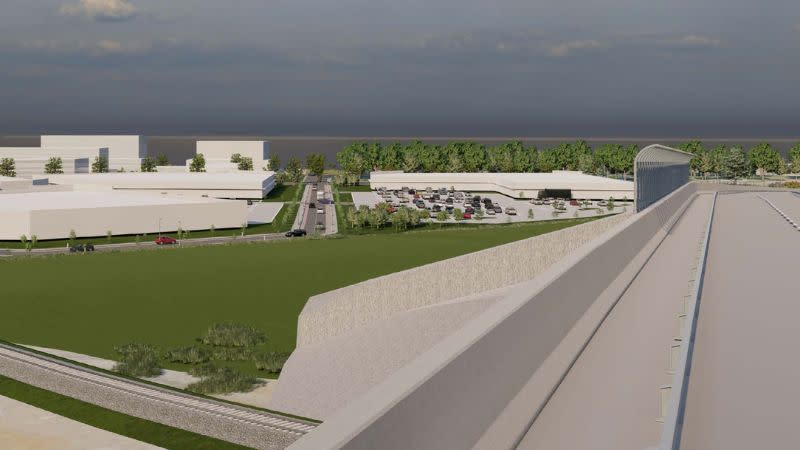
Dyson has earmarked the 163.8ha harbourfront site, 2km west of Albany’s historic town centre, for 15,110sq m of floorspace. The proposal includes a five-star hotel, food and beverage outlets, 1100sq m of retail space and a maximum of 330 homes for up to 858 people.
Originally from East Fremantle in WA, Dyson, whose father like him was a wool trader, said he got into the development game by “buying woolstores that big companies didn’t want”.
He owns six former woolstores around Australia including a high-profile one at Port Adelaide that has been converted into the popular Pirate Life brewery.
Dyson finished demolishing the Albany woolstores in 2024 and said he reused or recycled almost 90 per cent of the materials, including timber that he freighted across the border to include in his own house in South Australia.
The Albany site once stored wool from across WA’s Great Southern region for export through the Port of Albany. Against the backdrop of a long-term national decline in wool production, the Great Southern in 2024 produced 10 per cent of Australia’s clip—the most of any region.
Something in the water at Albany
In 2025, house prices at Albany soared by 23.4 per cent—higher than any other urban area in the nation, including capital cities.
Cotality’s Asia-Pacific executive research director Tim Lawless said Albany was at the top of the national list, followed by the City of Karratha in WA’s Pilbara region (where home prices grew 22.7 per cent in 2025) and the town of Warwick in Queensland’s southern Darling Downs (20.9 per cent).
“The list is very different now than it was five years ago,” Lawless told The Urban Developer.
“It tends to be more rural in nature and with much more affordable price points [in areas] that didn’t see the same growth through the pandemic that a lot of the higher profile markets did.”
He said the price growth at Albany had been driven by migration from a “bit further north in the state”.
“Albany is a lifestyle market; it’s coastal,” he said of WA’s southernmost and oldest settlement, which, three years before Perth, is this year commemorating its bicentenary.
“I wouldn’t describe it as commutable back to Perth, so I don’t think it’s remote workers going back to the office one or two days a week.
“I think it’s more a mature age demographic that’s looking for a sea-change opportunity at fairly affordable prices.”
In 2025, Albany’s 10-day average sale time and 1.9 per cent vendor discount rate were the lowest of any urban area in regional Australia. Of the nation’s 50 major regional markets, Albany, at 16.9 per cent, recorded the highest annual growth in residential rents.
The median price for a home in Albany at the end of 2025 was $783,389.
“So, it’s pretty affordable in that sense, especially for a coastal market that’s got a lot of amenity and appeal from a liveability perspective,” Lawless said.
He said Albany fell into the same category as other desireable regions across Australia that were not an easy commute to a capital city.
“Five years ago, or so, the markets that were the strongest performers were typically the Gold Coast, the Sunny Coast [including] Noosa, Byron, Newcastle, Woolongong [and] the Southern Highlands that were about lifestyle appeal but generally commutable back into a major city,” he said.
“The reality is that a lot of those markets that are very high profile are also now very unaffordable, so the trend now really seems to be quite different where the best performing markets are generally not really commutable into a capital city.”
He said that price growth in Albany—the only city on WA’s south coast and a tick over an hour’s drive further from Perth than west coast lifestyle hubs such as Margaret River—was off a much lower base.
“Albany didn’t see the same kind of growth that, say, Busselton or Bunbury did through the pandemic and ... some of those areas that are closer to Perth have probably had their run,” he said.
“They’ve moved beyond the affordability range for a lot of buyers.”

But Lawless did not expect the good times to roll on forever for Albany home owners.
“You wouldn’t expect this growth to be sustainable; if we were to speak next year you probably wouldn’t find values still rising at 23 per cent per annum,” he said.
“Albany is a market that has seen some growth in the last couple of years and if it continues at this rate it’s going to suffer the same slowdown as any other market that becomes unaffordable.
“You’d have to think that it’s moving through its peak rate of growth.”