
Sponsored ContentPartner ContentThu 08 Oct 26
The Monthly Payment Control That Is Setting Funds Apart

The Bathla Group collapse has put construction lending governance under the spotlight, and funds that once saw it as a handbrake on deals are starting to view it as the key to future capital allocation.
While addressing the Bathla fallout is the obvious priority for impacted funds, the tough questions will be coming even for those that weren’t: are they any better equipped to identify and manage the consequences of a distressed borrower/builder or were they just lucky this time?
Citing the standard risk controls around LVRs, security, diversification and risk management will do little to address growing scrutiny, as these are all established components of every lender’s framework.
And despite these ‘best practice’ protections, the market is currently reading about significant investor losses and funds gating redemptions.
There are lots of funds competing for the same capital.
In an increasingly selective (and nervous) market, we’re working with a growing group of lenders that have stopped viewing stronger financial governance purely through a deal execution lens, recognising that enhanced risk controls are a direct path to securing and retaining capital allocation.
The governance gap that most lenders are yet to fill
Investor capital is being advanced against certified progress on the assumption that it represents recoverable value.
But progress only equals recoverable value IF that progress has been paid for.
Construction lenders go to great lengths to ensure that they aren’t paying for work that hasn’t yet been performed; monthly drawdowns are contingent on independent verification by the QS that progress onsite supports what has been claimed. Logical.
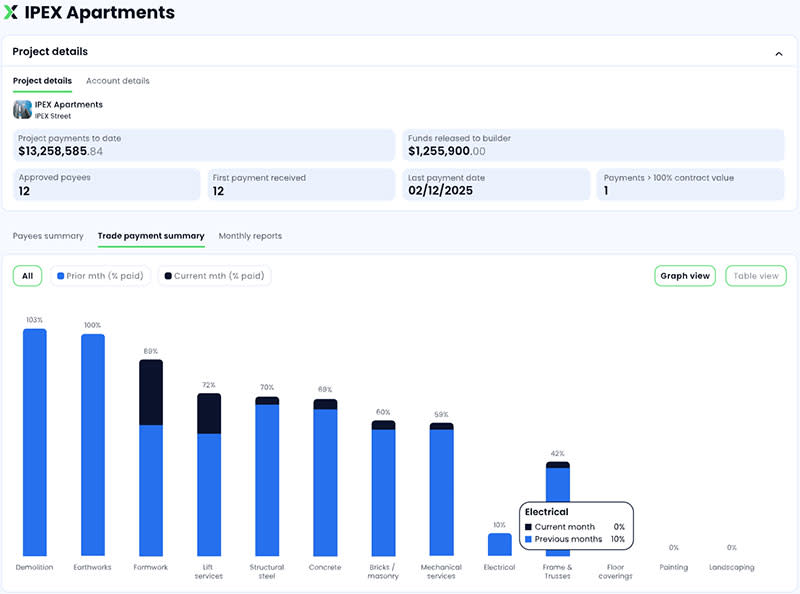
What’s less logical is that many lenders stop there; they verify that value has been created, but not that the funds advanced against that value have been used to pay for it.
Where certified progress remains unpaid, the expected link between drawdown and Cost to Complete, on which lender risk buffers rely, is broken.
The loan increases and reported Cost to Complete reduces accordingly, but the project’s actual remaining cash obligations remain unchanged.
The project still appears on budget but now carries a hidden funding gap. Risk forecasts are therefore incomplete (and, by extension, misleading), leaving lenders to make critical funding decisions without a clear view of their true exposure, or that of their investors.
The monthly payment control that is setting funds apart
A borrower or builder becoming distressed is difficult for a lender to predict or prevent. Allowing that distress to compound into significant leakage of investor capital is very clearly a failure of the lender’s controls.
Assuming that deployed capital has translated into recoverable asset value is a gamble and, as recent events have shown, an expensive one when you’re wrong.
An increasing number of lenders now independently verify that funds advanced against certified progress have reached the subcontractors and suppliers responsible for delivering it before advancing any more.
This simple monthly control allows the lender to identify early signs of capital ‘leakage’ into the builder’s working-capital position.

If the payment position falls outside tolerance at any point, the lender can stop or condition further funding, containing the problem before it compounds into a larger capital exposure. Investor risk can be capped.
This mechanism is missing from most construction lending governance processes and can be the difference between one bad drawdown and several.
Adapt before the market demands it
The payment blind spot is a known, systemic weakness in construction lending governance.
A solution is available, one that enables certified progress to be reconciled against live payment data at each drawdown without materially changing existing processes or adding operational burden to the lender.
Every lender says it has robust risk controls, but only some have chosen to independently track investor capital down to those that have done the work, ensuring ‘value’ created is both real and recoverable.
For these lenders, it’s not simply a risk control: it’s part of the investment proposition, a tangible demonstration that investor capital is being managed with a level of protection and oversight that exceeds what others can offer.
Those still prioritising money out the door over all else may soon find capital harder to come by.
The most attractive funds won’t be those reporting the lowest risk, but those capable of proving it.
Get in touch to learn more about the IPEX risk controls.
The Urban Developer is proud to partner with IPEX to deliver this article to you. In doing so, we can continue to publish our daily news, information, insights and opinion to you, our valued readers.