
Land & CommunitiesClare BurnettMon 28 Sep 26
Non-Bank ‘Stress Fractures’ as PAG Takes On Bathla Projects

As Bathla Group’s empire continues to crumble, Asian investment group PAG has reportedly taken control of several developments.
The lender is believed to be the largest involved with the insolvent Sydney real estate developer, and is attempting to recoup $300 million owed to it by Bathla.
PAG reportedly lent to Bathla for its projects in Western Sydney suburbs Box Hill, Marsden Park and the $230-million, 312-unit Peak Residences in Pemulwuy (pictured top), which it now controls.
Australian Retirement Trust, the nation’s second-largest pension fund, has an estimated $14 million exposure to Bathla via the PAG connection.
Teneo revealed last week that it had shut down the developer's 13 remaining construction operations after long-term funding attempts had failed.
But despite pressure from ASIC, Bathla Group administrators at Teneo have been tight-lipped on the funding agreements being made behind the scenes, and which projects have been taken over by their associated private credit lenders.
However, reports that billionaire Bob Ell has taken over projects in Marsden Park and Tallawong have surfaced.
LaTrobe Financial was one of the few to openly discuss its exposure. It admitted it had $38.1 million invested in Bathla, amounting to 0.15 per cent of assets under management. It said that its project was 95 per cent complete, and it had the full costs to complete it with presales covering 89 per cent of the loan balance.
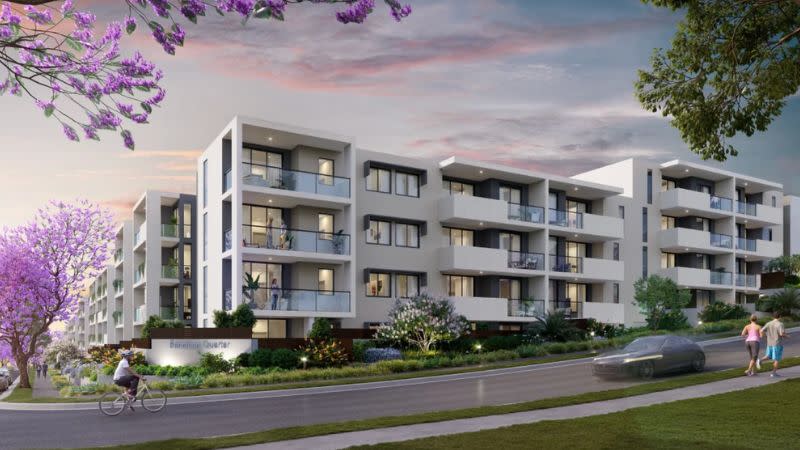
A list of Bathla projects current as of the date of administration was compiled by The Urban Developer, including the 339-home Sanctuary Quarter at Rouse Hill, which was being funded by Centuria Bass.
Centuria Bass announced last week that Sanctuary Quarter had received an occupation certificate, and it would progress the project through the settlement process for unit sales, including existing pre-sales.
It remained focused on the “orderly and timely recovery” of investor capital from exposures to Bathla Group.
The Bathla collapse has reportedly impacted 43 financiers, with $145 million owed to the Australian Taxation Office and $130 million to unsecured creditors. Around 600 subcontractors were also involved in Bathla-related projects, many of whom are likely to be unsecured.
Additional lenders include Balmain, Credit Connect, MaxCap, Ray White Capital, Wingate, CVS Lane Capital Partners, Keystone Capital, OSK Capital, Wentworth Finance and others.
The state of private credit post-Bathla
Private credit has become an attractive proposition for developers—growing as a sector by 500 per cent in ten years, according to ASIC.
To many, including ASIC, the fallout on the private credit sector from the Bathla collapse was inevitable.
“The events surrounding the collapse of Bathla are certainly deeply concerning, but for ASIC, unfortunately, they’re also not surprising,” ASIC commissioner Simone Constant said in a speech to the Commercial & Asset Finance Brokers of Australia summit earlier this month.
“To avoid these stress fractures becoming a stressed system, the sector must lift its standards and maintain them, consistently.”

Continued scrutiny has also affected the likes of Metrics Credit Partners, which called trading halts on three of its funds this week. It disclosed that $160 million had been slashed off their value following a tussle with similarly beleaguered auditors KPMG.
But while private credit has made headlines in the mainstream media, it might not be a death knell for the wider sector.
At an update on the Australian corporates market earlier this month, S&P Global Ratings—which recently downgraded the state of Queensland’s credit rating over its high infrastructure spending and operating deficits—said Bathla would have limited material impact on Australian property and private credit sectors generally.
The Bathla situation is significant for those involved, said S&P Global Ratings director Aldrin Ang.
“That said, we view the systemic risk to the broader private credit market as low,” Ang said.
“The Bathla situation represents only about 1 per cent of the Australian private credit market, and furthermore, most of the largest funds in the country had no exposure to them, from what I'm aware, and importantly, none of our rated Australian funds, public or private, had exposure to Bathla.
“In short, while we are watching the sector pretty closely at this stage, we don't see this as a contagion risk for the wider property sector.”
Find out more about the state of the private credit market in Adam Di Marco's discussion with Stamford Capital managing director Michael Hynes.





