
Sponsored ContentPartner ContentThu 09 Jul 26
Solving a Critical Infrastructure Problem on Constrained Sites

Water tanks have long sat low on the design priority list. They were specified late and chosen mainly on capacity and price. That approach is losing ground fast.
Urban density is rising. Sustainability targets are tightening. Developers are being pushed to treat water storage as core infrastructure, not a secondary utility.
Stormwater attenuation, potable demand reduction and water reuse now sit inside planning frameworks and sustainability ratings. Buffer capacity against a strained municipal network is becoming a real resilience issue, not a nice-to-have.
Kingspan Water Tanks, which supplies water storage solutions to the Australian property sector, said the shift reflects a broader change in how developers, architects and engineers plan infrastructure.
From commodity to designed system
Water storage today is less a product choice and more a system. It has to work with the architecture, the hydraulics and the digital design tools used to plan a project.
Developers who plan storage early find it easier to control costs. They can also optimise plantroom and basement layouts, and unlock space that would otherwise sit unused, including under-slab areas.
That shift matters most on tight sites. Basements are getting smaller. Footprints are getting stranger. Mixed-use precincts leave little room for a standard tank.
Developers increasingly want a solution that fits the site, rather than a site that has to fit the product.
Kingspan Water Tanks provides the answer
Kingspan Water Tanks has a broad product range, built around flexibility. Its made-to-measure steel tanks are manufactured in Australia from BlueScope Aquaplate steel.
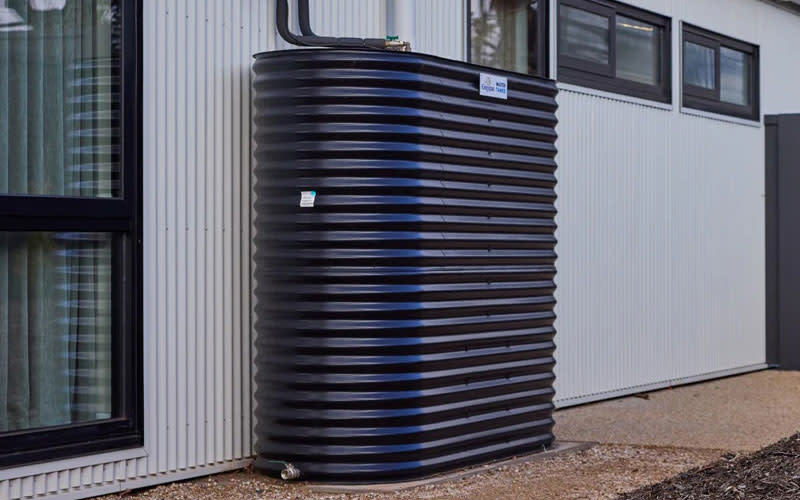
They come in Slimline, Round, Square and Modline configurations. Thousands of size combinations are available through the company’s 3D Tank Builder tool, which lets project teams test a design against a site’s real constraints at concept stage.
The range is WaterMark certified (Licence No. 23111), with wetted parts meeting the requirements of Australian Standard AS4020 and is available in a wide range of Colorbond colours.
For lighter jobs, the KPoly polyethylene range covers residential and light commercial projects.
Tanks come in Slimline, Round and Underdeck formats, from 1000L to 10,000L, and are backed by a 10-year replacement warranty.
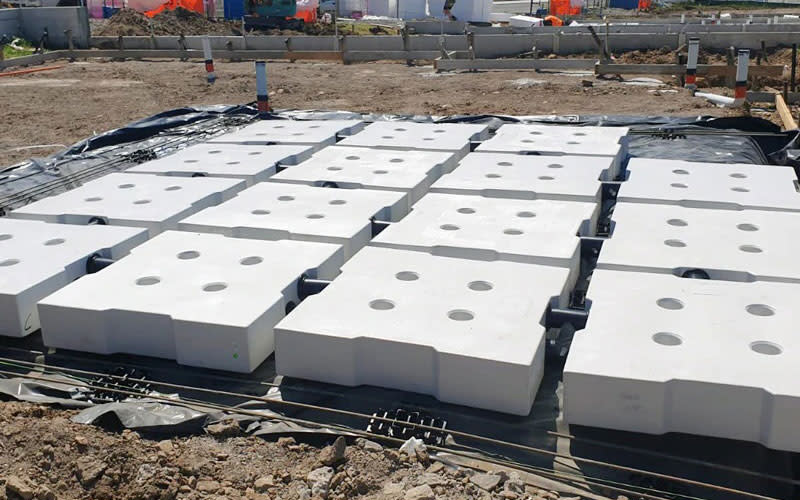
The Aquacomb in-slab system solves a different problem: instead of finding space for a tank, it removes the need for one.
Aquacomb comprises a series of interconnected storage pods which are housed wholly within concrete slabs or under any hard covered surface.
Kingspan Water Tanks’ commercial and industrial range runs from 12,900L to 20 million litres. It covers corrugated steel liner tanks, Glass-Fused-to-Steel tanks, and the company’s KSR round and KSS square industrial tanks.
These are built for potable water, fire protection, wastewater, mining and irrigation use, and are backed by technical advisory support through project delivery.
Digital co-ordination is changing the brief
Kingspan Water Tanks offers free BIM and Revit-ready files for its made-to-measure steel tank range, downloadable through its Architects & Specifiers portal.
This lets project teams drop tank models straight into a coordinated design environment. Clashes with structure and services can be resolved earlier. Penetrations and access points can be planned with more accuracy.
For architects and engineers working across complex, multi-consultant projects, that earlier coordination cuts redesign risk. It also improves documentation accuracy well before construction starts.
And it reframes the tank itself. It is no longer a fitting bolted on at the end. It is a modelled part of the building system from concept design onward.
What it means for developers
The case for treating water storage as critical infrastructure comes down to a few outcomes: stronger asset resilience, better ESG performance, greater planning certainty and lower operational risk over the life of a building.
As sustainability ratings and planning conditions keep tightening, water strategy is likely to become a standard part of early feasibility work, not a detail resolved once a scheme is otherwise finished.
The property industry is under pressure to do more with less land, less time and tighter compliance margins. Water storage looks set to move further up a developer’s agenda, not down it.
The Urban Developer is proud to partner with Kingspan Water Tanks to deliver this article to you. In doing so, we can continue to publish our daily news, information, insights and opinion to you, our valued readers.