ResidentialLindsay SaundersMon 02 Nov 26
Approval Figures Expose Uneven Recovery in Housing Pipeline

A surge for apartments lifted Australia’s approvals in September, but a sharp fall in detached-house permits exposed the uneven recovery in the housing pipeline.
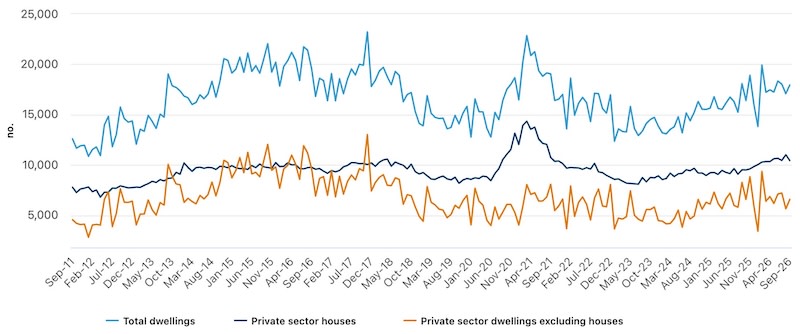
Total home approvals rose 5.1 per cent month on month to 17,948, seasonally adjusted, according to the Australian Bureau of Statistics (ABS).
The increase followed a 5.2 per cent fall in August and was driven by a 16.6 per cent rebound in private-sector homes excluding houses, which reached 6579.
However, private-sector house approvals fell 5.3 per cent to 10,432, the largest monthly decline since August 2025.
The September result was also 0.8 per cent below the same month last year, highlighting the limits of the monthly rebound.
Apartment approvals rose 25.6 per cent in original terms to 4129, slightly above the 12-month average of 4106.
New South Wales accounted for the biggest increase, with apartment approvals rising to 1995 from 901 in August.
Townhouses bounce back
Townhouse approvals also recovered, climbing 8.3 per cent to 2792 in original terms after falling 19.4 per cent in August.
Despite the monthly improvement, private-sector homes excluding houses remained 20.5 per cent below their September 2025 level.
The weakness in detached housing was widespread, with house approvals falling across every state: South Australia recorded a 7.8 per cent decline, Victoria fell 6 per cent, NSW dropped 5.5 per cent, Queensland slipped 5.1 per cent and Western Australia decreased 4.6 per cent.
The value of approved residential building work also fell, dropping 2.8 per cent to $11.06 billion.
New residential building approvals declined 3.3 per cent to $9.74 billion, while alterations and additions rose 0.8 per cent to $1.32 billion.
The broader value of building approvals rose 13 per cent to $19.02 billion, largely because non-residential approvals rebounded 45.9 per cent to $7.96 billion after a similarly sharp fall in August.
The trend estimate offered a steadier picture, with total home approvals rising 1.3 per cent to 18,705. The trend measure was 10.6 per cent higher than a year earlier.
Private-sector house approvals in trend terms edged up 0.1 per cent to 10,687, while approvals for homes excluding houses rose 3.5 per cent to 7708.
Homes approved, by building type, seasonally adjusted
HIA Senior Economist Tom Devitt said that the RBA had delivered four rate rises this year, with the possibility of more to come, but this is yet to flow through to approvals.
“Past momentum in the market from early 2025 to early 2026 is likely to sustain approvals at current levels until the end of the year,” he said.
“Leading indicators of home building activity such as new home sales have already started to reflect the impact of rising interest rates, surging fuel costs and cost of living pressures, and increasing taxes and restrictions on investors.”
Oxford Economics Australia lead economist Maree Milroy said forward orders pointed to a still healthy year for residential commencements in this financial year.
“However, a series of headwinds flagged over 2026 are compounding to drive a materially weaker medium-term outlook for residential construction,” she said.
“Renewed Middle East hostilities, persistent geopolitical tensions and threats to Saudi infrastructure are keeping oil markets disrupted, and we expect Brent to stay above US$100 per barrel into 2027.
“Our preliminary modelling in April estimated a total impact of 2-to-3 per cent on construction costs, on top of any ordinary price adjustments.
“The higher-for-longer oil profile, alongside an investment pipeline continuing to swell in key areas (eg data centres), suggests further upside risk to transport and input production costs.”
Urban Taskforce Australia chief executive Tom Forrest said housing prices had collapsed because of a “lack of confidence, not because governments at all levels have reduced the cost of construction”.
“The one area where this is not the case is in planning assessment and approvals, where significant change has been achieved,” he said
“As the cliché goes, you can’t live in a planning approval. If it is not feasible to build the new homes, the approvals will not result in the new housing we need.”