ResidentialLindsay SaundersSun 03 May 26
Apartment Sector Drags Down National Home Approvals

Home approvals slide back more than 10 per cent across March as apartments dragged down the national total, fresh data has revealed.
The total number of homes approved fell 10.5 per cent during the month to 17,300, according to seasonally adjusted data released by the Australian Bureau of Statistics (ABS).
ABS head of construction statistics Daniel Rossi said that the fall in total homes approved had been driven by a 26 per cent drop in private homes excluding houses, after a 101.1 per cent rise in the sector in February.
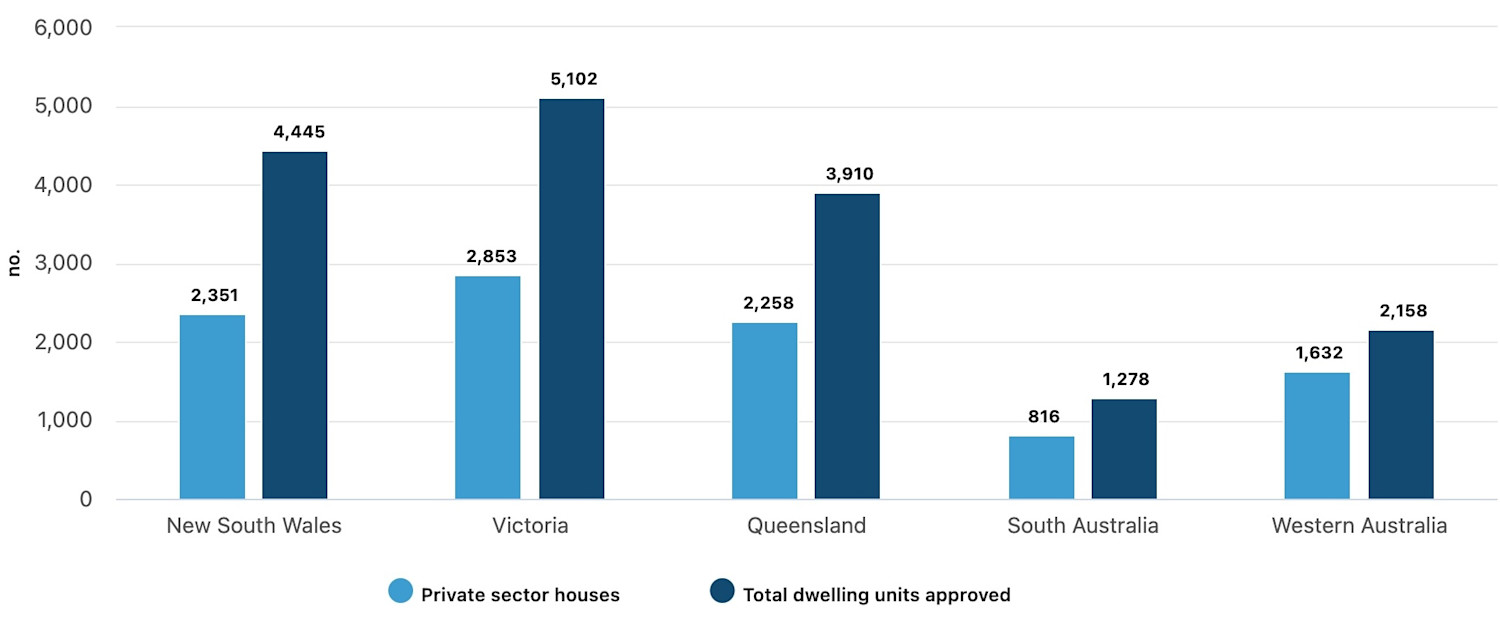
Private sector house approvals rose 0.9 per cent to 10,194 homes, 12.0 per cent higher than a year ago and the highest level since November 2021.
“New South Wales recorded the largest rise in private sector house approvals, up 9.5 per cent, to the highest level since August 2022,” Rossi said.
“This rise follows subdued levels for detached housing during the past few years.
“Western Australia had the largest fall in March, down 8.6 per cent. Despite the drop, house approvals remain higher than the 12-month average.”
The private sector homes approved decline, to 6632 homes, followed the previous month’s rise that was the highest level for the segment since June 2018.
In original terms, apartment approvals fell 30. per cent to 3,768 homes, lower than the average of the prior 12 months of 3872 homes, by 2.7 per cent.
Home approvals, March 2026
New semi-detached approvals rose 0.6 per cent in March, to 3051 homes, 5.9 per cent higher than the prior 12 months average of 2880 homes.
Residential and non-residential approval values also fellm down 19.4 per cent to $16.74 billion, coming off a record high in February.
Approved total residential building value dropped 15.8 per cent to $10.77 billion, which comprised a 17.7 per cent fall in new residential building to $9.43 billion and a 0.8 per cent rise in alterations and additions to $1.34 billion.
The value of non-residential building fell 25.3 per cent to $5.97 billion, after a 3.2 per cent February fall.
Oxford Economics Australia lead economist Maree Kilroy said that while favourable supply policies were setting a firm platform for the next building upturn, the construction sector faced increased headwinds that would likely temper the pace of growth.
“The Middle East conflict is already placing upwards pressure on construction costs, and another cash rate hike is expected tomorrow [May 5] to follow the increases in February and March,” she said.
“We don’t expect these drags on demand to fully materialise until 2027.”
Urban Taskforce Australia chief executive Tom Forrest said while it was difficult to draw any significant conclusions from a single month’s data, “the annualised results are starting to paint a picture of steady growth in new home approvals”.

“The national results for the 12 months up until the end of March 2026 show approval numbers touching on 200,000 per annum,” he said.
“That remains well below the number needed to deliver the Housing Accord targets (240,000 completed homes per year)—but the trend is on the up.
“However, the key now is to ensure that planning approvals are feasible to build.”
Master Builders Australia chief economist Shane Garrett said that with March 5’s interest rate decision looming, “any further interest rate increases will make it tougher to bring new homes into existence”.
“We’re really depending on higher density homes to help us reach the Housing Accord target. It’s worrying that activity in that part of the market shrank sharply during March,” he said.
“Builders are also reporting that impacts from the Middle Eastern conflict are making it considerably more expensive for them to undertake work.
“There is a danger that cost increases combined with higher interest rates could lead to market deterrence.”