

ConstructionLindsay SaundersWed 30 Nov 22
Building Approval Decline Eases as Construction Lifts

The nation’s residential building approvals have declined again, albeit at a lower rate.
Data from the ABS for approvals in October revealed a 6 per cent decline after an 8.1 per cent slip in September.
Dwelling excluding houses drove the decline with a 11.3 per cent decrease, while private sector houses were down 2.2 per cent, ABS director of construction statistics Daniel Rossi said.
Across Australia, total home approvals fell in NSW (-18.8 per cent), Queensland (-18.7 per cent), and Tasmania (-10.5 per cent), while South Australia (17.6 per cent), Victoria (5.8 per cent), and Western Australia (5.7 per cent) recorded increases.
Approvals for private sector houses were mixed, with Queensland (-13.8 per cent) and Western Australia (-0.4 per cent) down, while Victoria (1.1 per cent), NSW (0.2 per cent), and South Australia (0.2 per cent) rose in October.
The value of total building approvals fell 0.2 per cent last month after a 7.1 per cent decrease in September.
The value of total residential building approvals fell 2.1 per cent, comprising a 2.7 per cent decrease in new residential building and a 1.4 per cent increase in alterations and additions.
The value of non-residential building approvals rose 2.6 per cent, after rising 6.9 per cent in September.
BIS Oxford Economics head of property and building forecasting Timothy Hibbert said the substantial backlog of house and land sales made over 2021 that have yet to materialise would be sufficient to hold total approval volumes relatively flat for the next couple of months.
“The outlook for approvals deteriorates in the new year, with it becoming increasingly difficult for new projects to gain traction,” he said.
“Credit available has become a major headwind for new dwelling demand, with a few more interest rate hikes from the RBA expected to lift the cash rate to 3.6 per cent in early 2023.”
Hibbert said as well, greenfield land prices and construction costs had also lifted sharply, with the weighted average cost of a house and land package on the fringe of Australia’s major cities surging by 30 per cent since the start of 2021.
HIA economist Tom Devitt said although multi-unit approvals declined across the month, on a quarterly basis it was up by 13.9 per cent on pre-pandemic levels.
“Affordability constraints in the detached market, combined with tight rental markets and returning overseas migrants, students and tourists, are set to support demand for more affordable, higher density living,” he said.
“This means the multi-unit market is set to continue strengthening in the face of higher interest rates and a cooling detached market.
“A large pipeline of home building work is sustaining employment across Australia and continues to obscure the impact of rising interest rates on demand for housing.
“The 2.75 per cent increase in the cash rate will bring this pandemic boom to an end, but this is yet to be reflected in approvals data.”
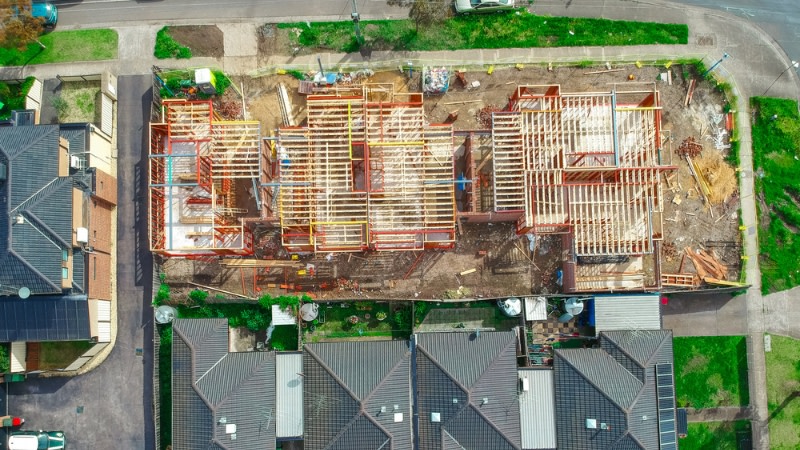
Also released by the ABS was its Construction Work Done data for the September quarter, which indicates a 1.2 per cent lift for residential building activity compared to the June quarter, equating to $24.150 billion.
Construction rises
Total construction work done for the quarter rose by 2.2 per cent to $54.787 billion.
The trend estimates for total construction work done fell 0.1 per cent in September.
BIS Oxford Economics head of global construction forecasting Nicholas Fearnley said the rise followed an unusually weak June quarter where bad weather, absenteeism, and supply issues all hampered housing construction work.
“While higher interest rates and increasing construction costs are weighing on demand for new homes, the substantial backlog of work that developed over the past two years will support growth over 2023,” he said.
“Non-residential building activity increased 1.1 per cent duringthe quarter. We expect activity to firm over the 2023 financial year, supported by a sizeable pipeline of public projects including schools, train stations and hospitals.
“Sectors hit hard by the border closure and movement restrictions are also expected to rebound, while the tailwind behind asset classes that have benefited through the pandemic, including warehouses and data centres, is set to persist.”
“Periods of high price growth are usually followed by a period of relatively flat price growth, as the gradual correction comes through in real terms.
“Ultimately, higher prices encourage a supply response, as higher wages attract more workers to the construction sector and stronger material prices encourage suppliers to bring more capacity online.
“The strong demand for construction activity, both domestically and globally, over the coming years ensures that the supply side response to high prices is unlikely to create a 'whipsaw' effect, whereby we see a sharp fall in construction costs.”





