

Sponsored ContentPartner ContentWed 14 Oct 26
How to Protect and Deliver Signature Design Features

Every ambitious development has a moment it is built around. A sculptural facade, a public artwork, a lobby that announces what the building stands for. These are the features that define a project’s identity.
They are also, according to Tilt Industrial Design chief executive Tim Phillips, the features most at risk of losing their value long before construction begins.
“Value engineering rarely compromises a design through one decision,” Phillips told The Urban Developer. “It typically occurs incrementally.”
That incremental erosion is what Tilt calls the design gap: the space between a feature as imagined and what survives design development, procurement, pricing and delivery.
It is rarely one bad call, Phillips said; it is the accumulation of many reasonable ones.
Where the gap opens
Developers might assume risk to a signature feature surfaces at tender, when contractors price the work and the market delivers its verdict. Phillips said the gap usually opens earlier.
“It often starts during design development, when a feature is visually resolved but not yet technically or commercially resolved,” he said.
At that stage, fabrication logic, access, maintenance, tolerances, sequencing, warranties and cost may still be unclear and that uncertainty ends up in the procurement stage.
“Procurement often exposes the design gap, but it usually opens earlier.”
A case in point
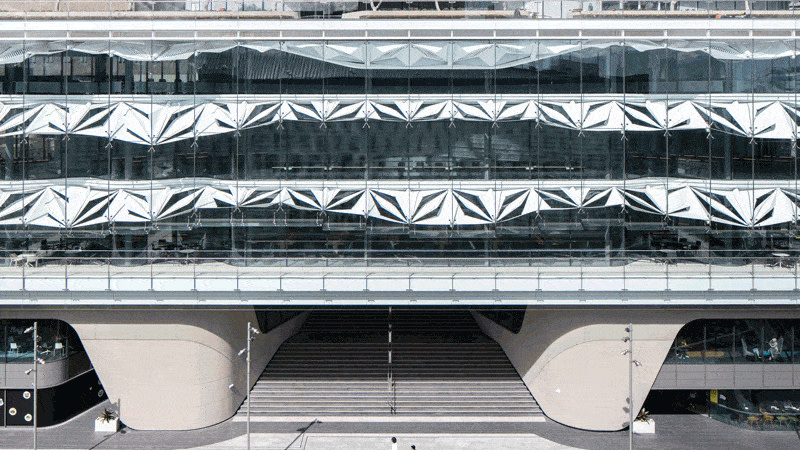
The architectural intent behind UTS Central’s automated sun-shading system was clear, but the pathway required to deliver it was not.
Once such a feature is broken into consultant packages, trade scopes and individual cost decisions, the original idea can be diluted one reasonable decision at a time.
Tilt’s role was to hold the feature together as a single system, spanning geometry, structure, interfaces, fabrication, installation and cost, resolving issues early enough that the design could stay ambitious without becoming commercially indefensible.
Systems, not trades
Complex features, whether a kinetic facade, a public artwork or a civic lobby moment, don’t often sit within one trade or discipline.
Design intent, feasibility, fabrication, installation, maintenance and long-term performance all need to be considered together rather than handed off in sequence.
“Conventional procurement optimises packages,” Phillips said. “Industrial design optimises systems.”
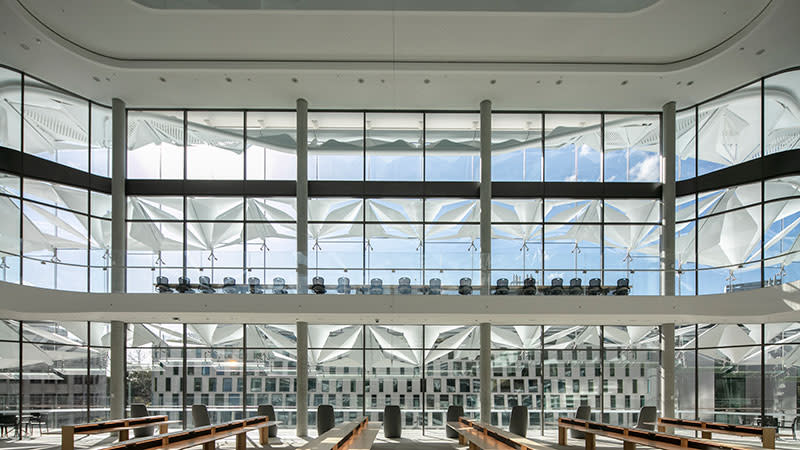
Tilt works alongside architects, engineers, artists, contractors and fabricators, maintaining an integrated view of the whole outcome so a change in one area does not undermine another.
What early really means
Phillips is specific on timing: late concept or early design development, not the tender stage most projects currently treat as the natural checkpoint.
“That is early enough to influence the feature, but late enough that the design intent is clear,” he said.
Wait until tender and geometry, interfaces, structural assumptions, services coordination and procurement structure are already fixed. Solving one problem then often means reopening several others.
The commercial upside is cost certainty. An unresolved bespoke feature is hard for contractors to price with confidence, and they respond rationally, with contingency, qualifications, exclusions or substitutions.
Where geometry, loads, materials, interfaces and installation logic are understood before tender, “the market can price something more real”, reducing both cost uncertainty and the risk of late redesign and variation.
Reading the warning signs
According to Phillips, a classic tell that a design is drifting from its original intent is when conversation shifts from the feature as a whole to isolated components and trades.
Phillips said the comments he hears, such as “we can simplify that fixing” or “change that material”, might each be reasonable in isolation, but the cumulative effect can be significant.
A second sign is less about language and more about accountability.
“When responsibility becomes fragmented, design intent becomes vulnerable,” Phillips said.
Unqualified provisional sums, repeated requests for information, heavy tender qualifications and late redesign requests are usually symptoms of the same issue.
Balancing ambition with reality
This is not about treating every element as sacred. The team at Tilt starts by identifying what makes a feature special, whether a geometry, a movement, a material quality or a cultural meaning, and protecting that idea specifically.
Once it is clear, the surrounding system can often be simplified through panelisation, a revised mechanism or a different fixing strategy, without changing what the public experiences.
“Good value engineering removes cost while protecting design intent and value,” he said.
His advice comes down to one principle: industrial design should be considered a core specialist discipline for complex design features, and its input should not wait until procurement.
“If a feature is important enough to define the identity of a project, it deserves to be treated as its own small project early,” Phillips said.
“Ambitious design survives when technical and commercial thinking develop alongside the idea, not after it.”
The Urban Developer is proud to partner with Tilt Industrial Design to deliver this article to you. In doing so, we can continue to publish our daily news, information, insights and opinion to you, our valued readers.