
ConstructionChris ThomsonThu 13 Aug 26
Bragg Urged to Simplify National Construction Code, Not Tear It Up

Industry groups have broadly welcomed a recommended overhaul of the stalled national construction code but are urging the Commonwealth not to throw the baby out with the bathwater.
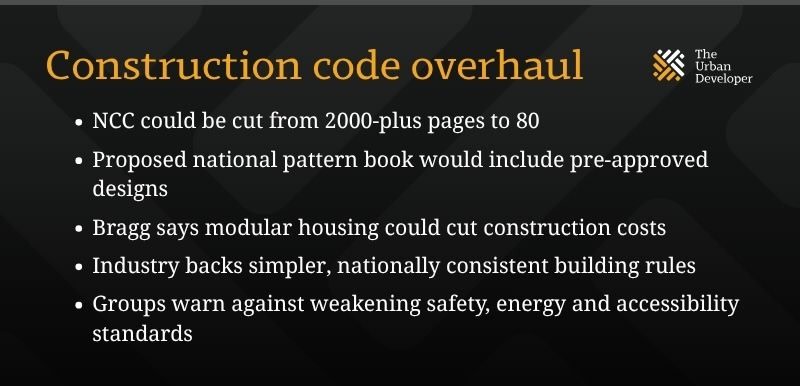
An interim report by the Senate Select Committee on Productivity in Australia has recommended the code be refocused on minimum safety and performance requirements. This would be done by introducing a basic Australian standard and a national pattern book containing pre-approved housing designs and modern methods of construction.
Speaking on the report at the National Press Club this week, committee chair Liberal senator Andrew Bragg said modular and prefabricated housing should make it cheaper than ever to build.
“Yet, high costs are making home building uneconomic,” Bragg (pictured above) said.
He said Australia needed a housing boom, which was impossible under current settings.
“The government has made the national construction code much worse,” Bragg said. “It is now illegal to build a cheap house in Australia.”
Bragg said the code should be wound back to 80 pages from its current 2000-plus pages.

Master Builders Australia chief executive Denita Wawn broadly welcomed the committee’s recommendations.
“The NCC is no longer fit for purpose and is adding thousands of dollars unnecessarily to the cost of building projects,” she said.
“We welcome the committee’s recommendation to refocus the NCC on minimum safety and performance requirements, as well as its recommendation that government procurement policies should not preference union-backed enterprise bargaining agreements.”
‘Knock-down, rebuild’, not a ‘renovation rescue’
Housing Industry Association industry and policy chief executive Simon Croft said the code needed a “knock-down rebuild, not another renovation”.
“But this should not be confused with a call to simply tear up the existing requirements that underpin the safety, structural integrity and performance of Australian homes,” he said.
“The much bigger and more immediate concern is the seemingly endless escalation of new requirements being added to the NCC and the growing tendency to use the building code to pursue broader policy objectives.
“The NCC should be a technical building document that sets clear, practical and proportionate minimum requirements for buildings.”
Croft said the Federal Government’s code-modernisation work, combined with a pause on further major changes to the code agreed late last year, was an important opportunity to reset and recalibrate the NCC.
‘Fragmentation the enemy of scale’
Australian Institute of Building Surveyors president Wayne Liddy said Bragg’s ambition to slash the code’s number of pages would underestimate the complexity of building safely across Australia’s diverse environment.
“It also does not acknowledge the NCC supports the construction of highly complex buildings such as apartments, data centres and hospitals where people live and work and are highly vulnerable,” he said.
“In Australia, we build across alpine and tropical regions, arid zones and coastal areas.
“You cannot simply remove that complexity from the code, because you cannot remove it from the environment we build in.”
But he agreed with Bragg that the extent of state and territory variations to the code, and extra technical requirements imposed outside the NCC, created unnecessary complexity.
“Australia should be working towards one consistent set of technical construction requirements across every state and territory,” he said.
“Fragmentation is the enemy of scale.
“Businesses need confidence that the systems, products and technologies they invest in can be used consistently around the country.”
‘Energy efficiency not an optional extra’
Australian Institute of Architects naional president David Wagner said the code’s reliance on devising performance-based solutions to address an absence of deemed-to-comply clauses made achieving building permits slower and more costly.
But he said a “wholesale slashing” was not the way to go.
“In particular, we caution against changes that would see things like energy efficiency or accessibility reduced to optional extras,” he said.
“Energy efficiency is not an optional extra; it can be the difference between whether someone on a low income can afford to heat their house or not in winter.
“Accessibility is not an optional extra; it’s crucial for supporting an ageing population and people with disability.”
The Labor members of Bragg’s committee, senators Lisa Darmanin and Michelle Ananda-Rajah, lodged a 4000-word comment piece on the report. This included a recommendation that the Commonwealth explore the use of artificial intelligence to streamline the code.
The committee is required to produce a final report by March 31 next year.