
InfrastructureVanessa CrollThu 18 Jun 26
Middle East Cost Shock Largely Misses Australian Tenders

The Middle East conflict has added as much as 3.5 per cent to Australian construction project costs, but domestic pipelines now pose the bigger threat to tender prices.
Rider Levett Bucknall’s Construction Market Update for Australia—June Quarter 2026 found sharp rises in diesel, freight and oil-linked materials had not produced the widespread escalation first feared.
RLB estimated the conflict added 1.5 to 3.5 per cent to total project costs, depending on location and exposure to freight, plant, civil works and imported materials.
Diesel and plastic pipe prices rose 25 to 40 per cent between February and June, while bitumen and asphalt increased 20 to 40 per cent.
RLB Oceania director of research and development Oliver Nichols said the initial surge created uncertainty across the industry and shortened tender validity periods.
“Diesel prices have since fallen from their peak, shipping pressures have stabilised, and several input surcharges have eased—reducing immediate escalation risk across most capital city markets,” Nichols said.
The report said developers became reluctant to sign new contracts, while contractors increasingly turned to early procurement and risk-sharing structures.
Nichols said tender pricing remained more stable than anticipated in Sydney and Melbourne, where competition led many contractors to absorb cost increases.
RLB expects the conflict’s direct effect on tender growth to fade from 2027, provided energy markets stabilise.
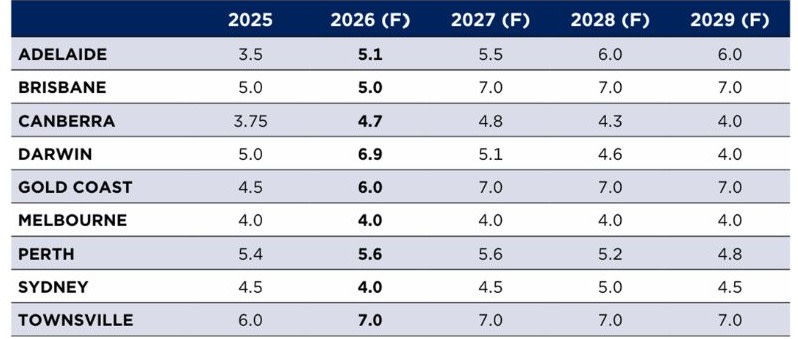
RLB Annual Tender Price Index [%]
Domestic workload pressures are proving more persistent.
Construction work reached a record $324.8 billion in the year to March, while data centre commencements jumped 208 per cent in 2025.
According to the report, the data centre pipeline is increasing competition for specialist trades, electrical equipment, cooling systems and grid connections.
Tender escalation forecasts remain at 4 per cent for Sydney and Melbourne.
Sydney offers a near-term pricing window before transport-oriented development, low and mid-rise housing approvals and data centres lift demand from late 2026.
Melbourne remains subdued, although labour shortages and limited subcontractor capacity continue to prevent prices falling.
Current market indicators
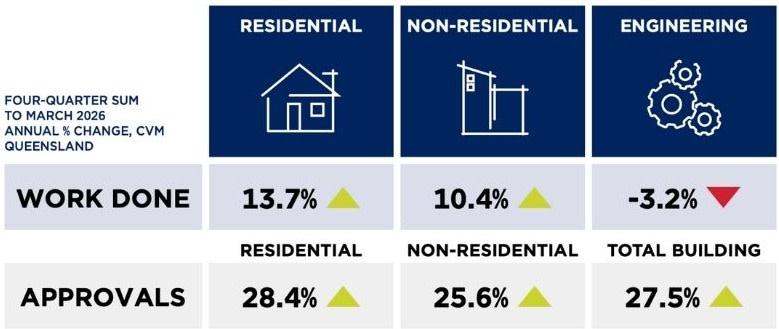
In Brisbane, delays to Olympics and hospital programs have created an estimated six-month window for shovel-ready projects.
Competition remains stronger below about $80 million in Brisbane and on the Gold Coast, while Tier 1 capacity tightens ahead of Olympic venue work.
The report said Townsville’s saturated pipeline and rising Brisbane 2032 activity would sustain pressure across Queensland, with potential flow-on effects for labour availability and pricing along the east coast.
RLB forecasts tender prices to rise 7 per cent in Townsville during 2026, followed by Darwin at 6.9 per cent, the Gold Coast at 6 per cent, Perth at 5.6 per cent and Adelaide at 5.1 per cent.
Canberra rose to 4.7 per cent as public work and reliance on interstate resources tightened capacity.
Australian Construction Industry Forum forecasts cited in the report now point to a 0.8 per cent fall in construction work during 2026, reversing earlier expectations for about 2 per cent growth.