
Sponsored ContentPartner ContentThu 19 Mar 26
MAS Architecture Changing the Multi-Res Design Narrative

Multi-residential architecture has one job: sell apartments.
MAS Architecture Studio founder and director Nick Symonds has spent 25 years refining a methodology built around that proposition—and it begins well before a single line is drawn.
“The goal of our design is to sell apartments—and the best way to do that is to come up with a story and a narrative that’s bespoke to that building,” Symonds told The Urban Developer.
Brisbane-based MAS Architecture Studio specialises in multi-residential, mixed-use and hotel projects.
Symonds established the firm five years ago after nearly two decades as a part-owner at DBI Design, where he ran the Brisbane office.
His experience spans high-rise delivery, procurement and market positioning, informing a process he calls narrative-informed design.
This process begins not with form, but with the buyer.
MAS investigates and analyses location, target demographics, spending capacity, apartment mix and the emotional drivers behind purchase decisions before a design concept is developed.
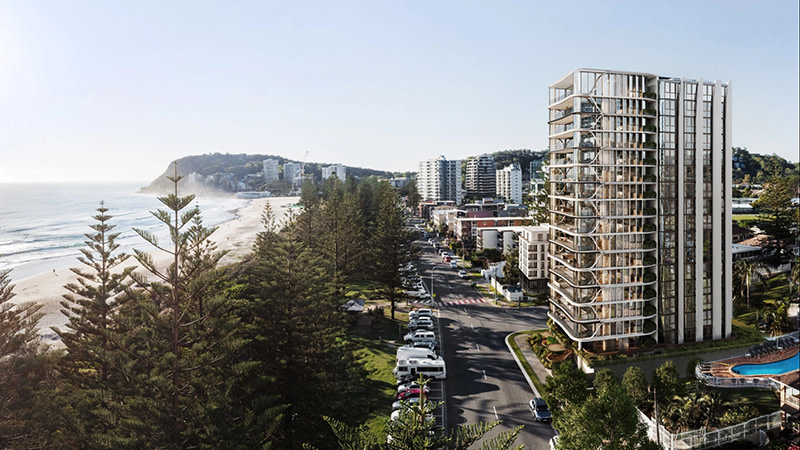
For a recently pitched South Brisbane project, he identified the primary buyer as an affluent professional aged 30 to 45—an owner-occupier already well-served by the precinct’s restaurants, parks and cultural institutions.
What that buyer lacked, he found, was somewhere to retreat from it.
“South Brisbane already has everything—what these future residents need is respite,” Symonds said.
That insight anchored every subsequent design decision.
Communal spaces were orientated inward rather than outward, prioritising privacy over street presence.
The building’s conceptual direction drew on themes of transformation and regeneration, informed by the precinct’s industrial heritage and extended through spatial planning, facade geometry, amenity naming and interior detailing.
Symonds describes this connective thread as a hook: an element embedded early in the design process that cannot be removed without undermining the whole.
Oria, MAS Architecture Studio’s highrise design at Spring Hill, shows how that hook performs under commercial pressure.
Research into the suburb’s heritage produced an art deco narrative that the studio used to shape the building’s distinctive shell facade—a geometry derived from archways and refined over successive iterations.
Situated at the highest point at Spring Hill, Oria is the first hig-rise approved under a new planning scheme and will be prominently visible from the proposed Olympic stadium precinct during the 2032 Games.
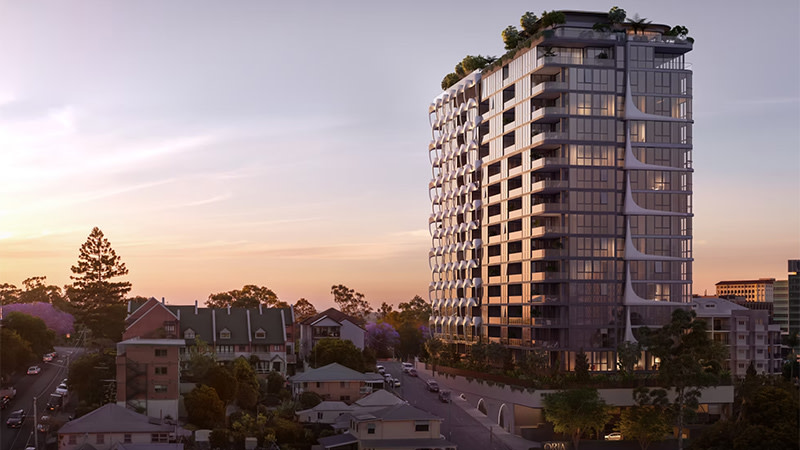
The design decisions that gave it a distinctive silhouette were made years before that visibility became a commercial asset.
Design coherence has commercial consequences beyond aesthetics. When architecture and interiors are bound by a shared narrative, Symonds said, the product becomes genuinely difficult to replicate.
Buyers encounter something they can describe and remember—and that distinction directly supports sales outcomes.
When projects stall
Cost to build is the most common reason a development stops progressing, Symonds said.
MAS Architecture Studio is regularly engaged to reactivate projects that have cleared design and approval but cannot advance to construction. The problem is almost always financial.
“Sometimes our approach is: have you considered building way less, but selling them for more, and making it a much better product,” Symonds said.
Structural and constructibility problems rank next, followed by unit hierarchies that place smaller apartments in premium positions—layouts that cannot achieve the per-square-metre values needed to make the project viable.
“You need to completely reset the entire hierarchy,” Symonds said. “All of a sudden you’re 20 per cent better than where you were before and now you’ve got a buildable project again.”
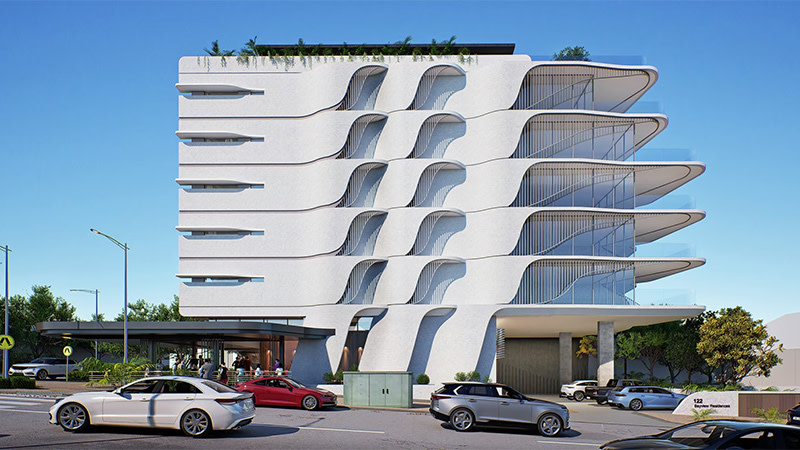
Once the commercial fundamentals are resolved, the question becomes what the project is actually selling.
Resetting the narrative is part of that process.
“A strong story informs planning decisions rather than adding to them,” Symonds said. “The orientation of a spa, the character of a communal space, the material palette of an entry-level finish, these things can be introduced or revised without necessarily affecting cost.”
What it changes is cohesion: the degree to which every element of a project is working toward the same outcome. Sales.
For MAS Architecture Studio, that is what every narrative-informed design decision is ultimately built to deliver.
“Every site has its uniqueness,” Symonds said. “Developers really need to be looking for architects who thoroughly understand the market and can extract the most value out of their product—rather than just design buildings that are nice.”
The Urban Developer is proud to partner with MAS Architecture Studio to deliver this article to you. In doing so, we can continue to publish our daily news, information, insights and opinion to you, our valued readers.





