
RetirementClare BurnettThu 05 Feb 26
Outdated Planning Challenges Hold Back Land Lease Boom

Land lease communities are a “powerful and underutilised solution” to Australia’s housing shortages but “outdated” planning frameworks need to be reformed to support its growth.
Older Australians will need 2.27 million homes by 2044 and the industry needs to position itself to supply the over-50s demand, research from Colliers and the Urban Development Institute of Australia’s NSW branch found.
Over-50s will drive 75 per cent of new home demand, the report said, and land lease communities were tipped as a “key solution” to the housing demographic, in which homes can be priced between 60 and 80 per cent of local median house values.
Communities can also be delivered up to 50 per cent faster than traditional housing models, and support more socially connected ageing.
But planning systems are constraining the delivery of “age-appropriate” housing at the scale required to support this surge in interest.
To deliver more land lease communities, planning frameworks need to modernise, especially in metropolitan and suburban locations where demand peaks, the report found.
Supply needs to be aligned with demographic reality, said Colliers head of data solutions Lynn Johnsen.
“Clear definitions, code-assessable pathways and regional land activation could unlock tens of thousands of dwellings, freeing up family homes and easing pressure across the housing continuum,” Johnsen said.
Household growth vs Land lease community pipeline by State
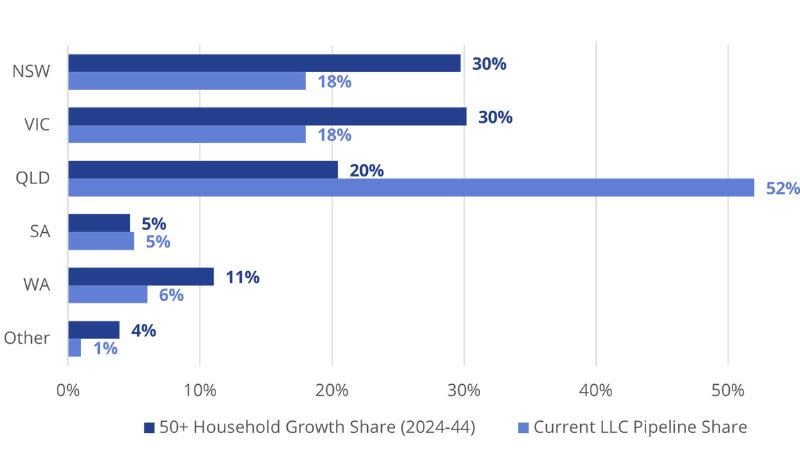
Australia currently has around 44,000 homes in purpose-built land lease communities. And Queensland accounts for 47 per cent of existing supply.
Colliers and the UDIA said that this reflected stronger private investment with clear planning pathways to supplying land lease communities in the state.
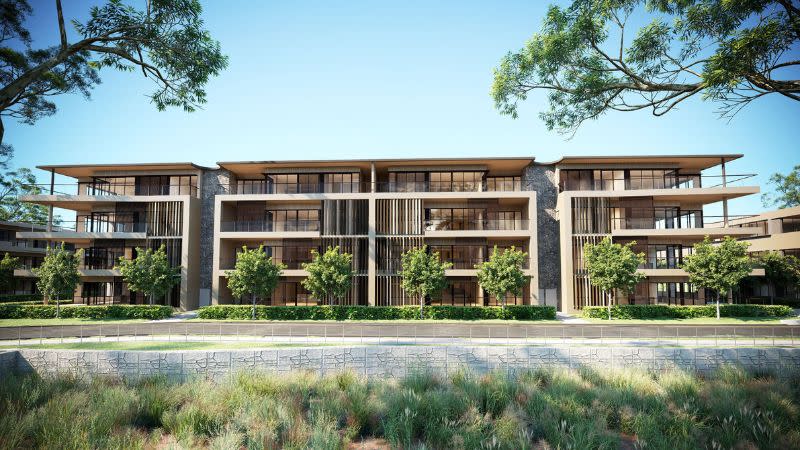
GemLife, for instance, has thrown its weight behind Queensland for its experiment into vertical land lease communities, with a $450-million project planned for Currumbin Waters which was approved in March after working with the City of Gold Coast Council.
Planning frameworks need to be reformed to keep up with the surge in demand for land lease, UDIA NSW chief executive Stuart Ayers said.
“We must expand the types of homes that genuinely meet the needs of this cohort, and land lease is one of the most efficient and scalable ways to do that,” he said.
Queensland’s traditional land lease pipeline is also robust, and regional areas have benefitted from the land lease boom.
Regional areas account for 59 per cent of existing land lease community supply and 73 per cent of planned developments are located in regional areas.
Ingenia is working on 166 land lease homes in Rochedale, while McGoverns is plotting a $100-million over-50s land lease project in Gympie and Bocina Group has filed plans for a $150-million community in Gatton.
But NSW and Victoria are falling behind.
The two states are expected to generate 60 per cent of future demand but hold only 36 per cent of the current pipeline, a deficit blamed on ongoing regulatory constraints.
While there are 43,000 homes currently in the national pipeline, the UDIA and Colliers forecast that 200,000 land lease homes will be needed over the next 20 years.