ConstructionHudson FarrFri 23 Oct 26
Construction Cost Rises Regain Pace After Softer Start to 2026

Construction cost growth has regained pace after a soft start to the year, and Western Australia is setting the pace.
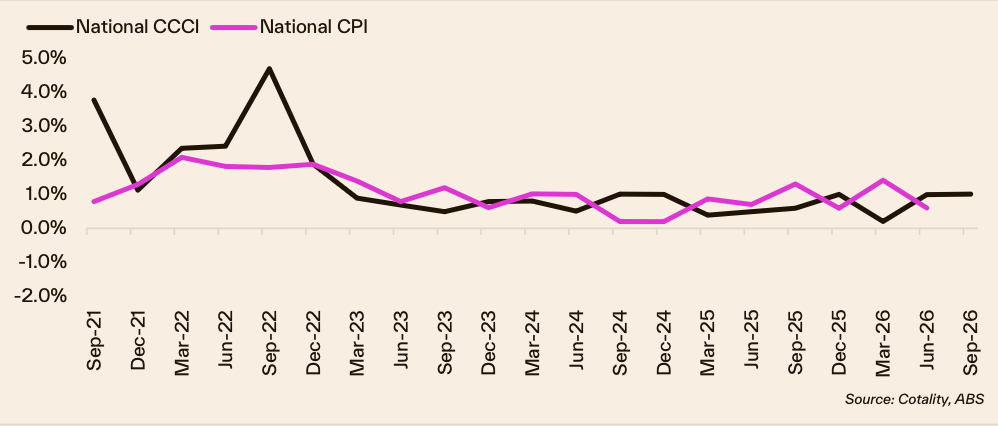
Costs rose 1 per cent nationally in the three months to September, up from 0.2 per cent at the start of 2026, according to Cotality’s latest report.
Over the 12 months to September, costs increased 3.2 per cent, compared to 2.8 per cent in the year to June.
Cotality’s report tracks changes in the price of labour, materials, plant hire and subcontract services across all major trades. It measures the change in the cost of constructing buildings, not the actual cost of a build.
Cotality Cordell Costings estimation manager John Bennett said the subdued start to the year was “an anomaly” and expectations of sustained cost easing “may have been short-lived”.
“The return to quarterly growth of [1 per cent] brings cost escalation back into line with the levels recorded in late 2024 and 2025, highlighting the continued resilience of underlying construction cost pressures across the country.”
Bennett said escalation remained historically subdued and below the rates seen through the post-pandemic period.
WA recorded the strongest quarterly rise at 1.1 per cent, while New South Wales and Queensland matched the national result at 1 per cent. Victoria and South Australia recorded the lowest growth at 0.9 per cent.
Annual growth was strongest in Western Australia at 3.6 per cent, followed by South Australia (3.5 per cent), Queensland (3.4 per cent), New South Wales (3.2 per cent) and Victoria (2.8 per cent).
Western Australia’s annual rate matched the 12 months to September 2025, and the report described it as the state’s strongest annual escalation since the post-pandemic period. It has recorded the highest rate nationally through 2026 and much of 2025.
Bennett told The Urban Developer the state’s lead came down to logistics and a reasonable amount of building activity, with materials from the eastern seaboard needing to be trucked across the country.
“We don’t see anything standing out there that would make us think that there was something extraordinary going on in Western Australia that wasn’t happening in the rest of the country,” Bennett said.
New South Wales eased from 1.1 per cent in the June quarter, but annual growth lifted from the 2.3 per cent recorded through most of 2025. The 1 per cent quarterly rate was last averaged in the state in 2024.
Victoria recorded 0.9 per cent for the second consecutive quarter. Its annual rate rose from 2.4 per cent in the June quarter.
Queensland’s annual growth lifted from 2.9 per cent a year earlier, although the quarterly result was marginally below its five-year average of 1.3 per cent. South Australia’s annual rate was up from 2.2 per cent.
All states remained below their five-year averages, with Queensland and Victoria performing slightly better relative to the national figure. The national five-year cumulative increase eased to 26.1 per cent from 29.5 per cent in the previous quarter.
Price movements varied across trades and materials. Plastics rose across the market and plasterboard recorded minor increases, while other costs moved up and down.
Bennett said the biggest movements were in materials that took a lot of logistics to get to site, including concrete, steel products and plasterboard, which were moved by “larger trucks rather than a small delivery truck”.
“Plastic pipe, obviously, is a byproduct of the petrochem industry, so every time that moves, it seems to be the plastics on the move again,” Bennett said.
Bennett said suppliers were returning to standard pricing cycles, but the broader market remained unsettled.
“Suppliers appear to be returning to standard pricing cycles, though ongoing adjustments continue across the sector.
“Additionally, some costs associated with the Middle East conflict may also now be flowing through to the overall material prices. These current developments are expected to place continued pressure on the already tight builders’ margins and overhead costs.”
Bennett said it was hard to say how much of the movement was due to the conflict, because Cordell did not usually see what was behind a price change.
“It’s very, very hard to gauge, because we don’t usually get that information on what’s behind the move,” Bennett said.
Bennett said uncertainty would continue through the rest of 2026.
“There is continued uncertainty in the construction sector. While underlying cost pressures remain evident, the timing and magnitude of future increases will largely depend on how domestic and global market conditions evolve, making this a key area for ongoing review.”