
ApartmentsLindsay SaundersWed 01 Apr 26
Apartment Sector Drives Home Approvals ‘False Dawn’

Home approvals have surged after two months of decline, rising more than 29 per cent for February.
The total number of homes approved rose 29.7 per cent in February to 19,022, according to seasonally adjusted data released by the Australian Bureau of Statistics (ABS).
ABS head of construction statistics Daniel Ross said the rise in total homes approved had been driven by a 101.2 per cent rise in private homes excluding houses.
“This follows a 25.0 per cent fall in private homes excluding houses in January and a 29.7 per cent fall in December,” he said.
“There has been a total of 195,434 homes approved, in original terms, over the past 12 months—a 9 per cent increase on the 12 months prior to that.
Private sector house approvals rose 0.2 per cent to 9847 homes, a 6.1 per cent rise year-on-year.
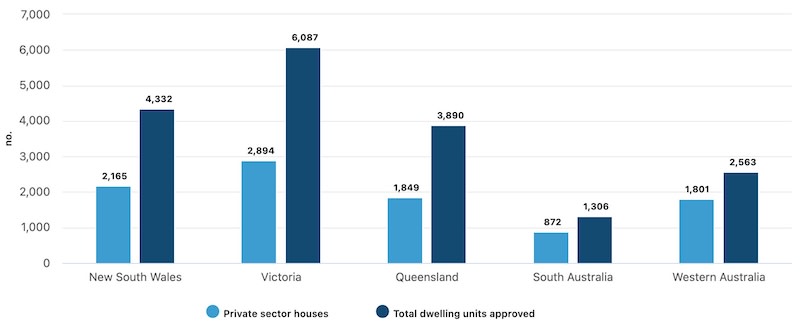
“New South Wales recorded the largest rise in private sector house approvals, up 13.7 per cent to the highest level since December 2023,” Rossi said.
“In contrast, Queensland had the largest fall in February, down 13.4 per cent.”
Private sector homes excluding houses (apartments and townhouses) rose 101.2 per cent to 8922 homes in February.
In original terms, apartment approvals rose 191.2 per cent to 5398 homes—29.8 per cent higher than a year ago.
Townhouse approvals also rose in February, up 73.8 per cent to 2981 homes, after a 38.7 per cent fall in January.
Homes approved by state, February 2026
The value of total building approved rose 14.4 per cent in February to $20.43 billion, after a 7.8 per cent rise last month.
Residential buildings drove the overall rise in building value, rising by 30.8 per cent (to $12.50 billion) to reach a new record high. The result was comprised of a 35.9 per cent rise in new residential building (to $11.21 billion) and a 1.2 per cent fall in alterations and additions (to $1.29 billion).
The value of non-residential building fell 4.4 per cent to $7.93 billion, after a 19.5 per cent rise in January.
Oxford Economics Australia lead economist Maree Kilroy said recent consumer confidence surveys have been dour.
“The reversal of the path for interest rates won't inspire a surge in confidence any time soon with household consumption to be increasingly driven by outright homeowners,” she said.
“Broadly, higher inflation will erode household incomes and delay home purchases with upside risk the longer the Middle East conflict lingers.
“However, Australia will retain an undersupply of homes for some years to come, representing pent-up demand support for residential construction.”
Uncharted waters ahead
HIA senior economist Tom Devitt said the rise in detached house and multi-unit approvals numbers had been on the back of elevated population growth, low unemployment and three interest rate cuts last year.
“Approvals in February will be more reflective, however, of new homes sold in previous months,” he said.
“The data doesn’t reflect the effects of two more recent rate hikes by the RBA, and the surge in fuel prices with the latest events in the Middle East.
Devitt sais that so far, events overseas represented a price shock, but not yet a supply shock.
“If [this] is short-lived, oil prices are likely to stabilise. In this scenario, there is good reason to believe that ongoing pressure on inflation and interest rates should subside,” he said.
“If overseas events persist, the likelihood increases that the current price shock will feed into future expectations, ongoing inflation and, therefore, even higher interest rates.
“It is all the more important now for policymakers to enact meaningful reforms that lower the cost of new home delivery.
“This means reducing taxes, not increasing them, pausing further regulatory changes, and addressing structural shortages of skilled trades.”





