

InfrastructureLeon Della BoscaWed 14 Jan 26
Melb Developers Sound Alarm on $34,000 Rail Loop Levy

Property developers building near Melbourne’s Suburban Rail Loop stations face charges of nearly $34,000 per home.
Under its funding model, the Victorian Government says the levy would raise $11.5 billion over four decades.
It comes despite industry warnings the levies could stall apartment construction and push housing prices higher.
Eighteen months after signalling developers would help fund the project, Premier Jacinta Allan announced the specific levy amounts at the SRL construction site in Heatherton late last year.
The value capture mechanisms detailed how the government would raise the sum to fund a third of the $34.5-billion SRL East project.
The announcement provided concrete figures for developer contributions that the industry has anticipated since mid-2024, when the government first flagged value capture mechanisms in its business case.
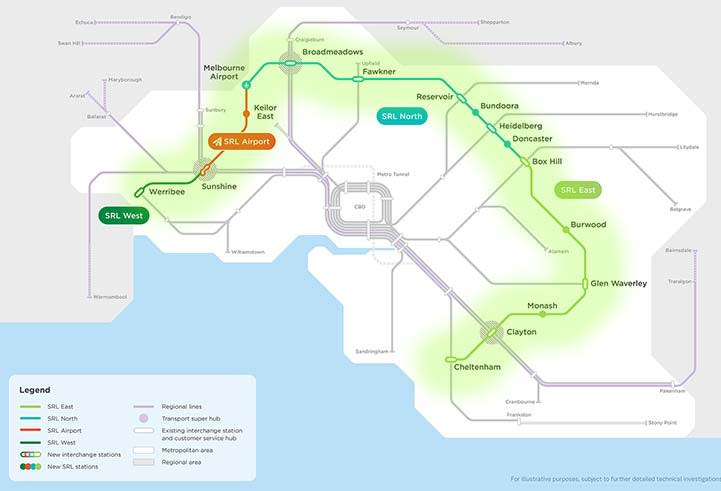
Developers would initially pay $11,350 per new home in SRL precinct structure plan areas from January 1, 2027, matching the levy being introduced around more than 50 train stations across Melbourne.
The levy would rise to $33,924 between 2032 and 2035 as construction progresses and the SRL begins operating.
The structure plan areas extend 800m from each station, with an outer ring area stretching between 800m and 1.6km from the stations.
The government expects to raise $2.9 billion through these infrastructure contributions.
“Those who financially benefit from investment in this sort of infrastructure can make a proportional contribution to the delivery of these projects,” Allan said.
The value capture plan comprises five mechanisms: existing land tax from investment properties in SRL East precincts would generate $5.75 billion, while windfall gains tax would raise $450 million.
A car parking levy on off-street parking owners would commence in 2035, raising $800 million.
State-initiated development on government-owned land would generate $1.6 billion once structure plans are finalised next year.
The government has said no mechanisms would apply to family homes and that land tax rates would not increase.
The Commonwealth’s expenditure review committee has “cautiously agreed” to release approximately $10 billion in additional Federal funding for the project.
Allan also announced the $6.7-billion linewide contract had been awarded to TransitLinX consortium, comprising John Holland, RATP Dev, Alstom, KBR and WSP, to build 13 four-carriage automated trains at Dandenong and operate the network for 15 years from 2035.
The contract follows the government’s earlier selection of Terra Verde—a consortium of WeBuild, GS Engineering and Construction Australia, and Bouygues Construction Australia—as preferred bidder for the northern twin tunnels stretching about 10km from Box Hill to Glen Waverley.
Housing Industry Association Victorian executive director Keith Ryan said the value capture mechanisms would “further compound the state’s housing affordability crisis”.
Property Council Victorian executive director Cath Evans said the proposal contradicted the government’s housing objectives.
“If projects proceed at all, it would only be by passing these costs directly on to home buyers—pushing prices higher and directly undermining the government’s own housing affordability objectives,” Evans said.
“Large-scale, high-density precincts of this size and complexity require significant domestic and international capital. Victoria is already struggling to compete for that investment. This proposal makes it even harder.
“At a time when investor confidence in Victoria is already at historic lows, the government is sending a clear message: take your investment elsewhere.”