OfficeLindsay SaundersMon 02 Nov 26
Office Vacancy Rises as Return-to-Work Push Fails to Lift Demand

Australia’s office market is struggling to turn workers’ return to the workplace into stronger demand for space, with vacancy rising and net absorption turning negative as businesses contain property costs.
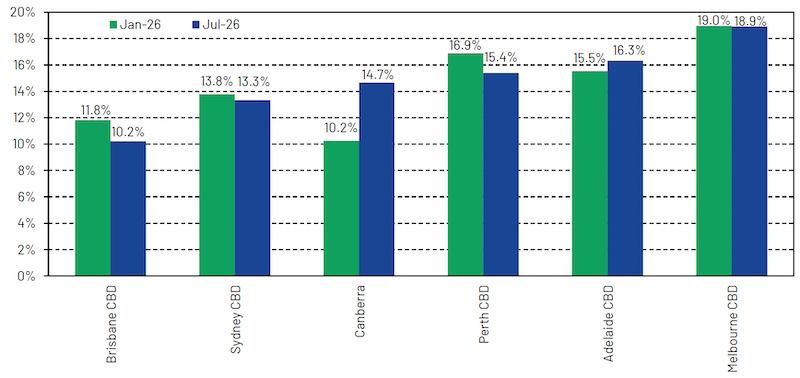
The Property Council of Australia’s Office Market Report found national office vacancy increased from 15.9 per cent to 16.1 per cent in the six months to July of this year.
Net absorption entered negative territory as occupiers handed back 7805sq m more space than they leased, reversing 51,966sq m of positive take-up in the previous half.
Annual absorption slowed to 57,161 square metres.
The figures highlight the widening gap between office attendance and businesses’ willingness to lease more space, as hybrid working arrangements, desk sharing and lease consolidation reshape demand.
Since January 2020, Australia’s office stock has grown by 2.3 million sq m, while occupied stock has increased by just 8568sq m to 23.1 million square metres.
By comparison, occupiers took up about 2.25 million sq m during the decade before the pandemic.
Ray White Group head of research Vanessa Rader said getting workers back to the office had “dominated the debate since 2020, but recent research out of the US suggests the harder question is what they do once they arrive”.
Rader said businesses were bringing staff back for part of the week while using desk sharing, hybrid rosters and lease expiries to maintain or reduce their office footprints.
‘In-office remote work’ on rise
The US research also identified a pattern in which employees commute to offices only to spend the day on video calls with colleagues working elsewhere, sometimes in the same building.
This “in-office remote work” is being driven by geographically dispersed teams and pandemic-era habits, Rader said, undermining the collaborative purpose of bringing staff together.
“If a mandated office day still delivers a day of video calls, occupiers have little reason to take more space,” she said.
The debate over attendance has shifted in Australia, with Victoria shelving its proposed legal right for employees to work from home two days a week before the November state election.
Meanwhile, transport and parking prices reflect the uneven distribution of office attendance across the working week.
Brisbane parking operators offer Monday and Friday early-bird rates about $10 below those charged from Tuesday to Thursday, while Sydney has discounted Friday public transport fares by 30 per cent.
CBD vacancy change: Six months to July 2026
The economic outlook is adding pressure on businesses to control costs.
Australia’s unemployment rate rose to 4.7 per cent in September 2026, with Victoria recording the highest rate among the states at 5.1 per cent.
The Reserve Bank of Australia lifted the cash rate to 4.60 per cent on September 29, its fourth increase this year and the highest level since 2011.
A fifth rise is widely tipped from November’s RBA meeting, due November 3.
Rader said a softer labour market could encourage employees to comply with attendance policies, while higher borrowing costs and slower hiring could prompt businesses to defer expansion or reduce their office footprints.
“The risk is that attendance rises for the wrong reason,” she said.
Build quality, location drive divergence
The market is also diverging by building quality and location.
Prime-grade office stock in Brisbane and Perth is tightening as new supply tapers, while secondary buildings face growing pressure to compete for tenants.
Rader said demand was concentrating in buildings that made in-person work worthwhile through better meeting and collaboration spaces, amenity and transport access.
“This brings back the ‘pivot to premium’ argument, leaving secondary stock facing the toughest test,” she said.
For developers and investors, the figures suggest that a recovery in office attendance will not necessarily deliver a corresponding recovery in leasing demand.
“The measure of office recovery needs to move beyond how many days staff attend to whether time in the office is productive enough to justify the space businesses pay for,” Rader said.
“With new supply tapering, prime stock in Brisbane and Perth is already tightening and the divide between assets that bring people together and those that simply house them is likely to widen from here.”