
Sponsored ContentPartner ContentThu 24 Sep 26
Certainty the Only Rate That Counts In a Shaky Market

A wave of lender collapses across the private credit sector has put a new word at the centre of every development finance conversation: certainty.
For some developers who have seen deals unravel mid-construction, the appeal of a slightly cheaper rate is losing ground to a more pressing question: whether a lender can see a project through to completion.
That means funding that does not dry up part-way through a build, pricing that does not shift once a deal reaches credit committee and a lender still answering the phone even when a market turns.
It is a lower bar than developers might expect but, according to GPS Development Finance executive director of lending Marnie Woodhead, one that a lot of the market is currently failing to clear.
“We’re receiving a lot more broker enquiry than we have in years, and a lot of the language we’re hearing now is ‘we’re looking for certainty of funds’,” Woodhead told The Urban Developer.
She said that more deals landing on her desk had been priced competitively, only for the developer to push back on the rate and take the loan elsewhere.
Months into construction, some of those developers returned, telling GPS their new financier had run out of money and stopped funding progress draws. In at least one case, the original builder called GPS directly, not a broker, not a call centre, and the business took over and completed the project.
Part of the reason GPS can step in where other lenders cannot comes down to how it is funded. GPS has its own investment arm known as Knox Funds which operates six funds, including the retail-facing Arkus, meaning GPS is not reliant on a single pool of capital.
“We’re not just wholesale dollars from Singapore. We’re not just family offices,” Woodhead said. “We can pull from our retail group, we can pull from our wholesale investors, we can pull co-lenders. Not everybody has as many levers to pull as we do.”

That depth backs a facility once it is signed, too. It is also, Woodhead said, the difference between a lender that can fund a project through a market wobble and one that will waver.
The cost of chasing the cheaper rate
The cost of a funding gap is rarely just the headline rate. Developers caught out by it have already paid finance fees to settle the original loan, then paid them again to settle a replacement only months later, on top of the delay to progress payments.
“That certainly would put a dent in their back-end profit,” Woodhead said.
And what should developers be checking in a lender before they sign? Woodhead’s answer has little to do with the interest rate.
“I think it’s just time in the industry, and a presence in the area you’re developing in,” she said.
Lenders chasing exposure to a booming market without a genuine local history, she said, are often making decisions about suburbs they have never set foot in.
“We’ve seen a lot of interstate money come into Queensland, but a lot of those lenders don’t have a long history here. The people you’re dealing with aren’t based here.
“So what I’d be saying for developers to look for is how long have they been lending in this market, and can they show they’ve funded project after project, through the cycle?”
That, she said, tells a developer more about reliability than any headline figure.
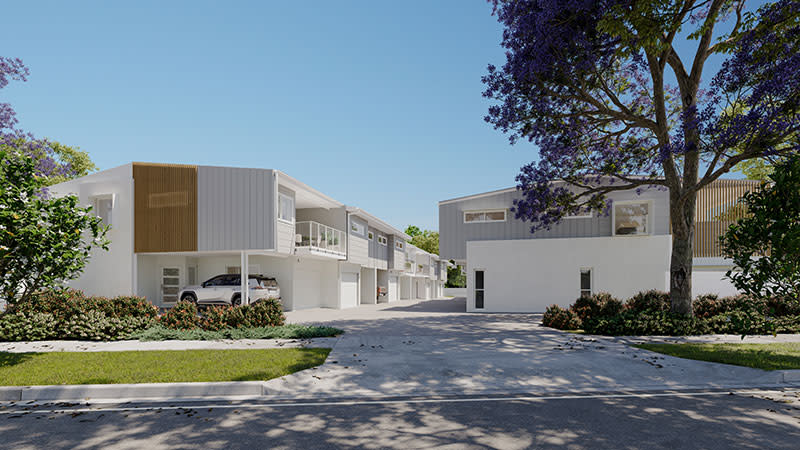
How GPS assesses a project
The business favours what it calls “boring is beautiful”: median-density townhouses and apartments in Brisbane’s middle and outer-ring suburbs, including recent projects at Richlands [pictured at top] and Beerwah.
It is a deliberately unglamorous product mix, chosen because it carries a higher degree of delivery certainty than higher-density, higher-risk builds.
Rather than leading with credit criteria alone, GPS focuses on who is delivering the project, “backing the jockey, not the horse”, as Woodhead put it.
Around 90 per cent of new clients arrive through referral from an existing relationship, a reflection of a market where reputations travel fast, and where a lender’s own track record counts for as much as the borrower.
Where certainty gets traded away
For developers, the temptation is to price certainty out of the equation entirely, chasing the lowest number on a term sheet without asking what stands behind it.
Marketing claims promising settlement without a valuation, for instance, are a warning sign rather than a selling point.
“Sometimes the best offer isn’t actually your best offer,” Woodhead said. “We don’t change the deal. We don’t change the rules.”
Many of GPS’s clients return project after project, some now on their tenth development with the business.
“That’s where developers get certainty,” Woodhead said. “We have a strong track record in the industry.”
The Urban Developer is proud to partner with GPS Development Finance to deliver this article to you. In doing so, we can continue to publish our daily news, information, insights and opinion to you, our valued readers.





