
ExclusiveTaryn ParisFri 19 Jun 26
Sites, Settlements and Silver Renters: Inside Ingenia’s 2026 Growth Story

Powered By NBN

Ingenia Communities is tracking toward the top of its 2026 financial year earnings guidance as its development pipeline swells to more than 8000 lots.
Ingenia’s June business update confirmed the land lease, rental and holiday park operator was on track to record an EBIT for the 2026 financial year between $180.5 million and $188.7 million.
That is up 10 to 15 per cent on the prior financial year, with underlying earnings per share growth of 5 to 10 per cent.

The group is forecasting 560 to 575 home settlements for the year, backed by 428 deposits and contracts already in hand.
In its first half report for the 2026 financial year, its total Lifestyle Rental (comprising rental, land lease communities, and development) was valued at $1.74 billion, across a total of 7200 lots.
Margins are moving in the right direction too, ahead of the group’s full-year results in late August.
Ingenia is forecasting both gross margin and average sale prices to lift on the prior period as the portfolio shifts to positive net cash generation per lot — a sign the development engine is now converting volume into value, not just chasing settlement numbers.
Ingenia chief executive John Carfi said the group was “well positioned to deliver at the top of guidance” despite pockets of buyer caution and extending settlement timeframes in some markets.
Carfi said cancellations have remained in line with prior periods, and interest in recent releases had been strong.
The demand backdrop
But the settlement growth isn’t happening in a vacuum.
Urbis’s latest Living Sectors Market Insights puts the scale of the structural tailwind in stark terms.
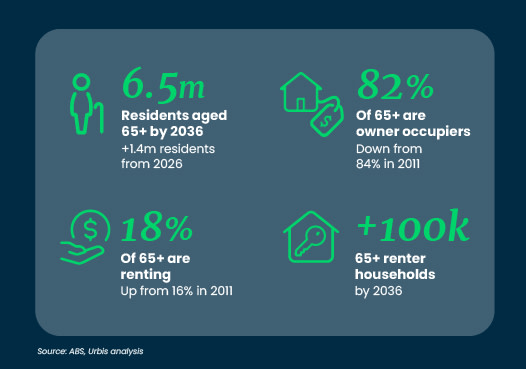
Australia’s over-65 population is forecast to grow by 1.4 million people to 6.5 million by 2036, while the share of older Australians who own their home outright has slipped to 82 per cent, down from 84 per cent in 2011.
It’s a slow but steady erosion of the traditional ownership-led retirement pathway that’s pushing more downsizers toward rental and land lease markets.
Within the broader seniors housing market, Urbis splits demand into retirement living (44 per cent), aged care (42 per cent) and communities — the land lease category Ingenia operates in — at 14 per cent.
It’s the smallest slice today, but Brisbane director Michael Cattoni said it was where the real growth is concentrated.
“The seniors living sector is running at three speeds… aged care is proving more challenging and slower, yet retirement living is continuing with good growth,” Cattoni said.
“Meanwhile, communities are the primary growth area, offering a more affordable downsizing option and faster delivery timeframes that allow supply to scale quickly and absorb unmet demand.”
Price growth backed by the numbers
The Urbis report also provided hard data to support the pricing logic underpinning Ingenia’s margin story.
In Yeppoon — home to Ingenia’s 322-home Seagrove development at Taroomball — new land lease product was selling at a median $590,000, an 11 per cent discount to the broader house price median, compared with a 49 per cent discount for traditional retirement living in the same market.
Port Macquarie showed a similar pattern: land lease at $835,000 is just 13 per cent below house prices, compared with a 27 per cent discount for the retirement product.
There’s a tailwind on the rental side of the business too.
Urbis flags the rise of the “Silver Renter” — older Australians who hold considerable home equity but are choosing to rent for flexibility and lower maintenance — with 18 per cent of the 65-plus cohort now renting, up from 16 per cent in 2011.
Renter households in that age bracket were projected to grow by more than 100,000 by 2036.
Pipeline pushing past 8000 lots
Ingenia has contracted or settled close to 1600 potential land lease lots across six sites in NSW, Victoria and Queensland so far in the 2026 financial year, with a further 2000 lots across eight sites in NSW and Victoria secured and earmarked for contracting and settlement across the 2027 and 2028 financial years.
Another 670 lots are in due diligence. Combined, that lifts the total pipeline to more than 8000 potential lots, with more than 3200 sites already approved.
It’s a build-up consistent with the group’s target of 10 to 15 per cent compound annual growth in settlements through to the 2029 financial year and it has been underpinned by some sizeable individual deals.
Among the acquisitions feeding that pipeline: a 200-home 13.3ha land lease site in Townsville’s North Shore precinct, picked up from developer Oreana; an $11 million holiday park acquisition at Kinka Beach near Yeppoon; and Ingenia Holidays’ first move into the Whitsundays, with a coastal park acquisition at Conway Beach.
To fund the next leg of growth, Ingenia has also kicked off a capital recycling program, targeting around $140 million from the sale of lower-growth assets, with proceeds to be redirected into the higher-return development pipeline.
Building for a 10-year horizon
Behind the pipeline numbers sits a less-publicised decision—who builds the network underpinning each community.
And the case is sharpened by who’s buying into Ingenia’s communities.
The buyer base is trending younger—working-age downsizers running remote jobs, multiple connected devices and smart home setups as standard rather than optional extras.
Ingenia has switched providers to nbn’s Smart Solutions program.
Nbn says the move followed problems with service responsiveness, recurring upgrade costs and a lack of forward planning on how technology would evolve across the portfolio.

The replacement is full fibre, installed once per site rather than being upgraded piecemeal as needs changed.
“This fundamental choice of broadband network operator is a serious and permanent decision,” nbn executive general manager for new developments Andrew Walsh said.
Walsh said ripping out and reinstalling core network infrastructure mid-build is expensive and disruptive, so getting the design right at the outset matters more for assets meant to operate for decades.
And topping the list of residents’ requests is CCTV, access control, energy monitoring and resident apps, deployed as standard inclusions across new communities rather than bolted on site-by-site.