
IndustrialTaryn ParisFri 02 Oct 26
Flight to Quality Feeds Prime Industrial Market: Report

Demand for logistics and industrial space across Australia’s major markets held up in the third quarter, but the gains were far from evenly shared according to Cushman & Wakefield data.
Prime industrial space absorbed 650,000sq m in the three months to the end of September, while secondary stock went backwards by 300,000sq m, as occupiers use lease events to trade up and supply tightens in the best-located precincts.
Cushman & Wakefield’s Q3 industrial report shows more than 1 million sq m was leased in the quarter, lifting gross national take-up to about 3.4 million sq m year-to-date.
Net absorption was positive at 350,000sq m and vacancy was steady according to the report.
Beneath that headline figure, the market is bifurcating further.
Cushman & Wakefield’s head of logistics and industrial research Luke Crawford said the flight to quality was “shifting up a gear” in major markets.
“Growing occupier selectivity is concentrating demand in prime grade space,” he said.
“Occupiers continue to use leasing events as a catalyst to optimise and modernise operations as they seek to stay competitive and manage costs amid economic uncertainty.”
Crawford said the shift helps explain why secondary space makes up more than 70 per cent of available stock in Adelaide and a growing share of on-market space in Brisbane.
National net absorbtion by grade, 12 months to Q3 2026 (sq m)
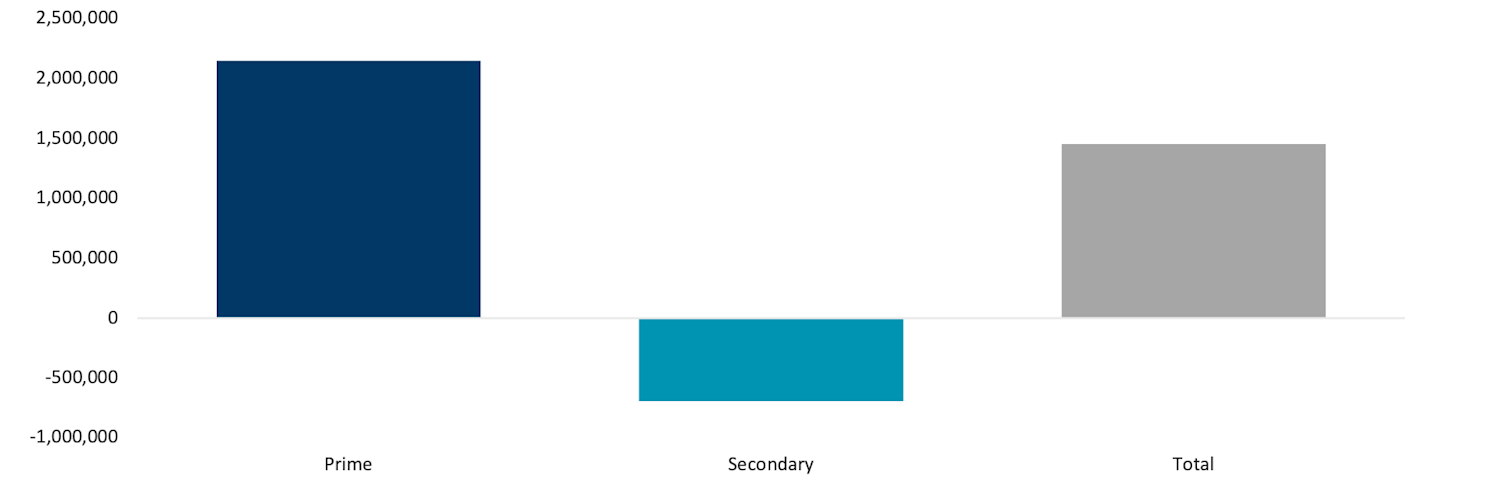
“In Sydney, prime stock is leasing in almost half the time of secondary options, while older, less functional buildings are behind much of the vacancy increases in Melbourne’s north and west precincts,” he said.
Crawford said while vacancy was steady at 3.7 per cent nationally, the figures were diverging across the capital cities.
Perth represents the tightest market with a 2.2 per cent vacancy, while Adelaide and Brisbane were both tightening to 2.6 per cent and 3.1 per cent respectively.
Sydney charted a modest rise to 3.9 per cent, and Melbourne was the highest vacancy rate at 4.4 per cent off the back of a number of new speculative completions.
Rental growth continued to slow as the market digests a 75 per cent rise in rents since 2021.
Face rents were broadly stable in the quarter as occupiers gained more choice and landlords competed through incentives. Adelaide, Brisbane and Perth continued to lead annual growth.
The research suggests supply will define the next stage of the cycle. Higher costs, planning delays and land shortages are constraining pipelines, and developers are increasingly requiring pre-commitments before they build.
“Planned pipelines are unlikely to translate fully into completed stock, which will keep conditions tight in the best-located precincts,” Crawford said.
“With limited new prime supply on the horizon, we expect the flight to quality to only intensify.”