

RetailChris ThomsonMon 24 Aug 26
Bunnings’ Planned Exit from Bunbury Birthplace Voted Down

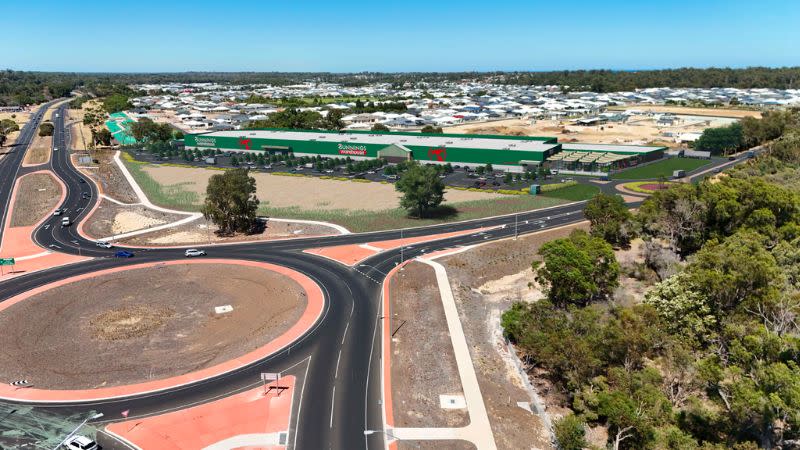
A new warehouse that would have catalysed a controversial exit by Bunnings from the regional Western Australian city reputed to be where the hardware giant was born has been refused.
On August 19, WA’s statutory planning committee overturned a recommendation of approval from state planning director Paola Di Perna for an 18,834sq m Bunnings warehouse at 538 Bussell Highway, Dalyellup.
The committee’s vote (based on grounds including that the warehouse would detract from the amenity and character of the surrounding area) was not unanimous—two members voted not to support the refusal.
Bunnings had planned to build a $40-million hardware outlet to replace the exising outlet 8km to the north in the centre of the regional city of Bunbury on a 5.1ha site earmarked for residential rather than commercial development.
Bunbury city councillor Cheryl Kozisek, who in June moved to oppose the relocation, had said Bunbury was the birthplace of Bunnings.
“They opened the first store in Bunbury in 1906,” she told a council meeting on June 9.
“We are the community that helped establish them in the market.
“We are the people that supported them; our grandparents, our parents.”
Cr Kozisek said the focus for Bunnings at the beginning was sawmilling.
“Timber from the Southwest was a very sought-after building product, in particular jarrah, and jarrah railway sleepers from the Southwest have been exported all over the world,” she said.
“The Southwest was dotted with saw mills; I had to question my father on this, so Donnelly River Mill, Quinninup Mill, Dean Mill, Pemberton, Shannon, Nannup, Palgarup, Nyamup, Northcliffe, Walpole, Tone Bridge and Collie.
“My father carted timber from every single one of those mills.”
The planned move raised the ire of Bunbury business owners who said it would have sucked commercial life from the centre of their 1836-founded city.
But the adjoining Shire of Capel, where the growing outer suburban Dalyellup sits, welcomed the new Bunnings, arguing it would have promoted commercial activity and establish an entry statement there.
‘Net community benefit’
During the project’s consultation period, 220 submissions were received, with 181 supporting the new Bunnings and 34 opposing.
People who supported the plans said Dalyellup needed retail infrastructure to reduce reliance on central Bunbury.
Bunnings forecast that the new warehouse could have generated $56.6 million in sales in its first year of trading, assumed to be 2027-28. On the flipside, its economic analysis showed the Bunbury CBD could have suffered a $26.4 million, or 5 per cent, reduction in turnover annually.
But the assessment concluded the impacts would remain “broadly within normal competitive ranges” and not undermine the viability of surrounding centres.
Di Perna considered the proposal, which would have had 396 car bays and nine bicycle bays, could have delivered a net community benefit.
The new Bunnings would have occupied two consolidated sites, one owned by the Free Reformed Church of Bunbury and the other by Riverview Nominees (WA) directed by farming industry group Western Dairy’s vice chair Robin Lammie and Bertha Lammie.
Bunnings’ relocation plans were on the table as Ray White CSR chief executuve Julie Ryan said the large-format retail sector was one of Australia’s most resilient commercial real estate asset classes.
“Yields and returns on LFR assets are currently outperforming standard enclosed shopping centres, industrial warehousing, and CBD office spaces,” Ryan said.
“In Australia, LFR retailers have robust balance sheets, strong consumer appeal, and product offerings that are inherently resilient against e-commerce disruption.”
Accounting for roughly a third of retail space in Australia, LFR generates about $1 out of every $4 spent at Australian retailers.