



Contractors for $488m NSW Central Coast Highway Fix Revealed
Lindsay Saunders
Sponsored ContentPartner ContentThu 26 Nov 26
Ron Bakir questions how things have always been done and explains why collaboration from day one is essential for better outcomes…

The cheapest problem to solve in development is the one that never happens, according to Homecorp chief executive Ron Bakir.
Getting there, he told The Urban Developer, means rethinking how everyone involved in a project works together from day one.
“We’ve got planning authorities, consultants, developers, builders, subcontractors and financiers, all operating within the same ecosystem, but often working to different priorities and timelines,” Bakir said.
“Each party might think it’s operating efficiently within its own business, but that doesn’t necessarily mean the overall development process is efficient.”
For Bakir, the fix isn’t a single policy lever, it’s designing efficiency into the entire development lifecycle, rather than bolting it on once the major decisions have already been made elsewhere.
Get that right, and the savings show up long before completion: shorter timelines, lower holding costs, and fewer of those costs passed on to buyers already stretched by the affordability crisis.
A common culprit, according to Bakir, is the disconnect between design and construction. An architect produces a design that “looks spectacular”. The builder picks it up only to find it’s barely buildable.
By the time construction expertise enters the process, the opportunity to simplify materials, cut unnecessary complexity or improve buildability has usually passed.

Homecorp’s response has been to collapse that sequence, bringing development, design, procurement and construction together at the outset rather than progressively through the project.
On one of Homecorp’s residential developments, early collaboration turned a costly design problem into a genuine win.
The original concept plan ran external platforms along the building’s western facade across 13 or 14 levels, to house air-conditioning condensers.
Brought in early, the construction team suggested a simpler solution: relocating the condensers to the roof.
The space freed up on each floor was folded back into the apartments themselves, turning two-bedroom layouts into three-bedroom apartments, at a lower cost than the original design.
“Genuine efficiency comes from how you collaborate at the outset, not just building something cheaper, but thinking smarter and eliminating waste,” Bakir said.
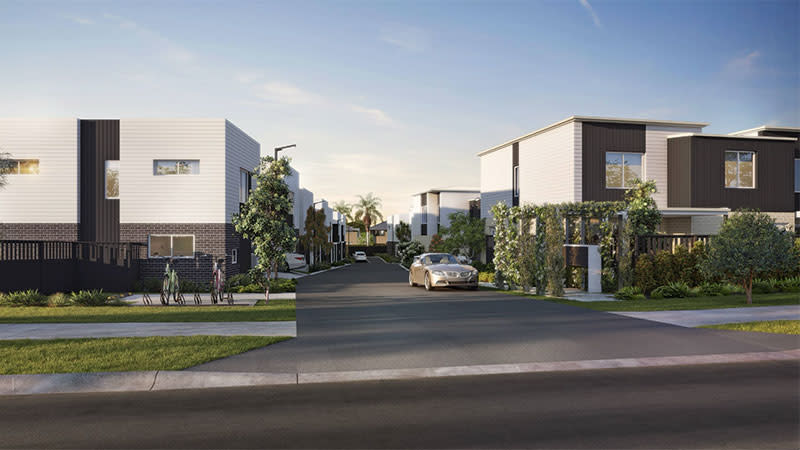
Streamlining the process only matters if it produces something worth building.
“Ultimately, as developers, we need to do what’s best for the customer and the long-term community,” he said.
Community starts with what surrounds the homes. Bakir cited a Harvard study that tracked people across their lifetimes and found the happiest were those with a strong sense of belonging, within a 15-minute walk of the essentials.
That means planning retail, medical services and infrastructure in from the start, then creating events and spaces where neighbours can meet.
“We can build hundreds of beautiful homes, but that doesn’t automatically create the community,” he said.
At Cienna Varsity Ridge on the Gold Coast, Homecorp is putting that thinking into practice.

Bakir said the level of amenity and connectivity there is unmatched by any other project in the Gold Coast’s affordable segment, and he expects Homecorp to deliver many more like it.
While being a developer-builder clearly has its advantages, the approach is not exclusive to developer-builders, Bakir said.
“Any developer can get design, construction, procurement and sales around the table before the first line is drawn, because a decision made early saves months later,” he said.
“And start with the customer and the community in mind rather than any one party’s priorities.
“Plan essentials within a short walk and give neighbours reasons to meet. Keep challenging how things have always been done.”
At Homecorp, that thinking has a name: Kaizen, the Japanese philosophy of continuous improvement, which the company adopted as a core value alongside its own “go beyond”.
It’s a line of thinking he said the industry may do well to adopt, too.
“You’ve got to be prepared to go beyond in every way, shape or form,” Bakir says.
“We’ve got to challenge the status quo. We either evolve or we dissolve. There’s no in between.”
The Urban Developer is proud to partner with Homecorp to deliver this article to you. In doing so, we can continue to publish our daily news, information, insights and opinion to you, our valued readers.

Lindsay Saunders