
Sponsored ContentPartner ContentWed 06 May 26
What’s in the Ground Decides What the Project Costs

Most contamination problems on development sites are not problems of contamination or disposal. They are problems of timing.
By the time something unexpected is found in the ground, the program is set, the budget is committed, and the pathway through approvals has already been chosen. Whatever is uncovered next must be managed within a structure that in many cases had not allowed for it.
At that point, contamination stops being a technical issue and becomes a commercial one.
For developers, this typically happens during enabling works, when demolition, excavation, services, approvals and remediation all begin to intersect. If the front end has been underestimated, even a manageable issue can quickly affect cost, sequencing and momentum.
The disposal cost ladder
Classification sounds technical but the commercial logic is simple. Soil and material leaving a site must go somewhere, and the regulator decides which facilities can accept it based on what is in it.
The cleaner the classification, the more facilities are available, the lower the haulage cost and the faster the site clears.
Disposal pricing moves in tiers and the gap between tiers is where projects lose money.
General solid waste sits at the bottom. Then Virgin Excavated Natural Material and Excavated Natural Material where eligible. Then contaminated soils on restricted pathways. Then asbestos-impacted soils. Then hazardous waste such as PCBs.
At the top sits leachable hazardous material, where controls are tightest and accepting facilities are fewest.
Moving up one rung tightens controls, narrows the field of facilities and lengthens haulage. Moving up two rungs can multiply the disposal estimate.
Get it right early and the disposal pathway is straightforward. Get it wrong, or late, and the pathway changes, along with the program and the cost.
Most developers do not understand which rung they are on until costs are already escalating.
When classification shifts mid-project
Even on well-investigated sites, classification can change once works are under way.
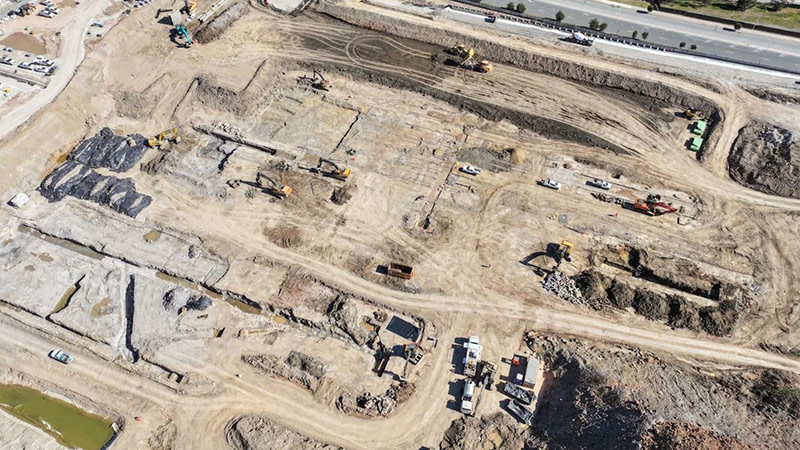
At Horsley Park, on a former industrial site at Austral Plant 3, routine analysis carried out by the Perfect Contracting team during the demolition phase identified PCBs that had not been flagged in earlier investigation.
The disposal pathway changed. Controls were tightened, excavation and disposal were redirected to approved facilities, and barrier systems were introduced to manage the affected ground.
The project absorbed the change because the program had already allowed for classification to move, with time, haulage budgets and access to approved disposal facilities for a higher category built into the plan from the start.
Without that contingency, the same finding becomes a stop-work event with no clear path forward.
The lesson is not that PCBs are hard to manage. It is that classification needs room to move in the program before the program is set.
Where approvals quietly fail
Contamination is rarely the only thing on the critical path. It sits alongside utility disconnections, anchor and shoring approvals, traffic and hoarding permits and the engineering interfaces that carry conditions of their own.
The pattern that catches most project teams is administrative rather than technical. Disconnection applications lodged by the wrong party or too late. Anchor and shoring approvals not mapped against the demolition methodology, so a third-party engineering sign-off lands after the contractor is already on site. Permits that arrive with conditions contradicting the staging plan or the contamination controls.
Each of these is a small failure on its own. Stacked, they can reset the program.
The way through is clear ownership, with every application, design input and approval condition assigned to one person, well before it falls due.
The decisions that protect the program
Contamination, classification and approvals are not separate problems. They are versions of the same question: how much of the risk on this site has been resolved before the program is locked in?
Even with thorough investigation, things turn up that were not in the report—a live underground service, a buried drum, a pocket of ACM in fill that was logged as clean.
What separates a manageable discovery from a project-shifting one is whether the response is already defined in the contract before the find.
The projects that move through complex ground quickly are not the ones that got lucky. They are the ones that asked the right questions and brought in specialist contractors while the answers could still shape the program.
Download the Contamination Pitfalls Guide for PMs to see how Perfect Contracting approaches enabling works risk on complex sites.
The Urban Developer is proud to partner with Perfect Contracting to deliver this article to you. In doing so, we can continue to publish our daily news, information, insights and opinion to you, our valued readers.





