
OfficeLindsay SaundersMon 10 Aug 26
Capitals’ CBD Offices Resilient as Vacancies Hold Steady

Australia’s CBD office markets have shown signs of resilience despite economic uncertainty, with five of six monitored markets recording positive net absorption during the second quarter of 2026.
Research from JLL found the national CBD office vacancy rate remained unchanged at 15.3 per cent over the 2025-26 financial year, as occupiers continued to commit to higher-quality workplaces.
JLL head of research Australasia Andrew Ballantyne said organisations were continuing to make leasing decisions despite fragmented business confidence.
“The second quarter results demonstrate the resilience of occupier demand across Australian office markets,” Ballantyne said.
“Organisations continue to progress leasing decisions and remain acutely aware of the importance of real estate as a strategic enabler for their talent and growth strategies.”
Sydney’s CBD office market recorded its fifth consecutive quarter of positive net absorption, with 9500sq m taken up during the second quarter and 96,000sq m over the 2025-26 financial year.
The Sydney CBD vacancy rate fell to 13.9 per cent, its lowest level since the first quarter of 2023.
Ballantyne said leasing momentum had shifted beyond Sydney’s core precincts, with Midtown and the Western Corridor attracting stronger tenant demand.
“Positive leasing activity in these precincts highlights the diverse nature of tenant enquiry in the Sydney CBD and a willingness to commit to higher quality assets,” he said.
Demand for premium office space continued to drive the Sydney market, with prime-grade assets recording 105,500sq m of net absorption over the 12 months to June 2026, compared with a 9500sq m contraction across secondary stock.
Australian capital city CBD net absorption, by quarter
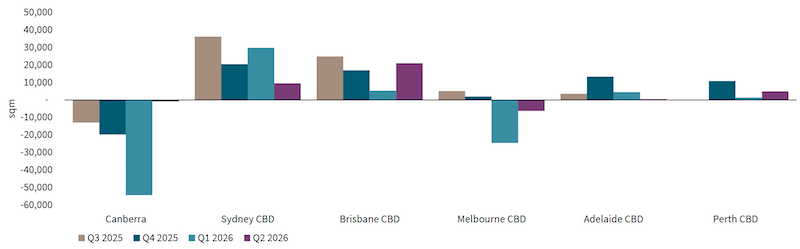
Brisbane was the strongest-performing CBD office market nationally, recording 21,000sq m of net absorption in the second quarter and 68,000sq m over the year to June 2026.
The result represented 2.8 per cent of total CBD office stock, with vacancy tightening to 10.6 per cent and prime-grade vacancy falling to 7.7 per cent.
JLL head of office leasing Australia James Montague said limited availability was reducing options for larger occupiers.
“The Brisbane CBD office market is tightening and the options for mid and large-sized space users have diminished,” Montague said.
He said while low vacancy had historically supported new development cycles, higher construction costs and builder capacity constraints were creating challenges for new speculative projects.
Prime gross effective rents in Brisbane increased 8.3 per cent over the 2025-26 financial year, with increased investor interest in the market.
Melbourne remained the weakest-performing CBD office market, recording negative net absorption of 6300sq m in the second quarter and 23,900sq m over the financial year.
The Melbourne CBD vacancy rate increased to 20.5 per cent.
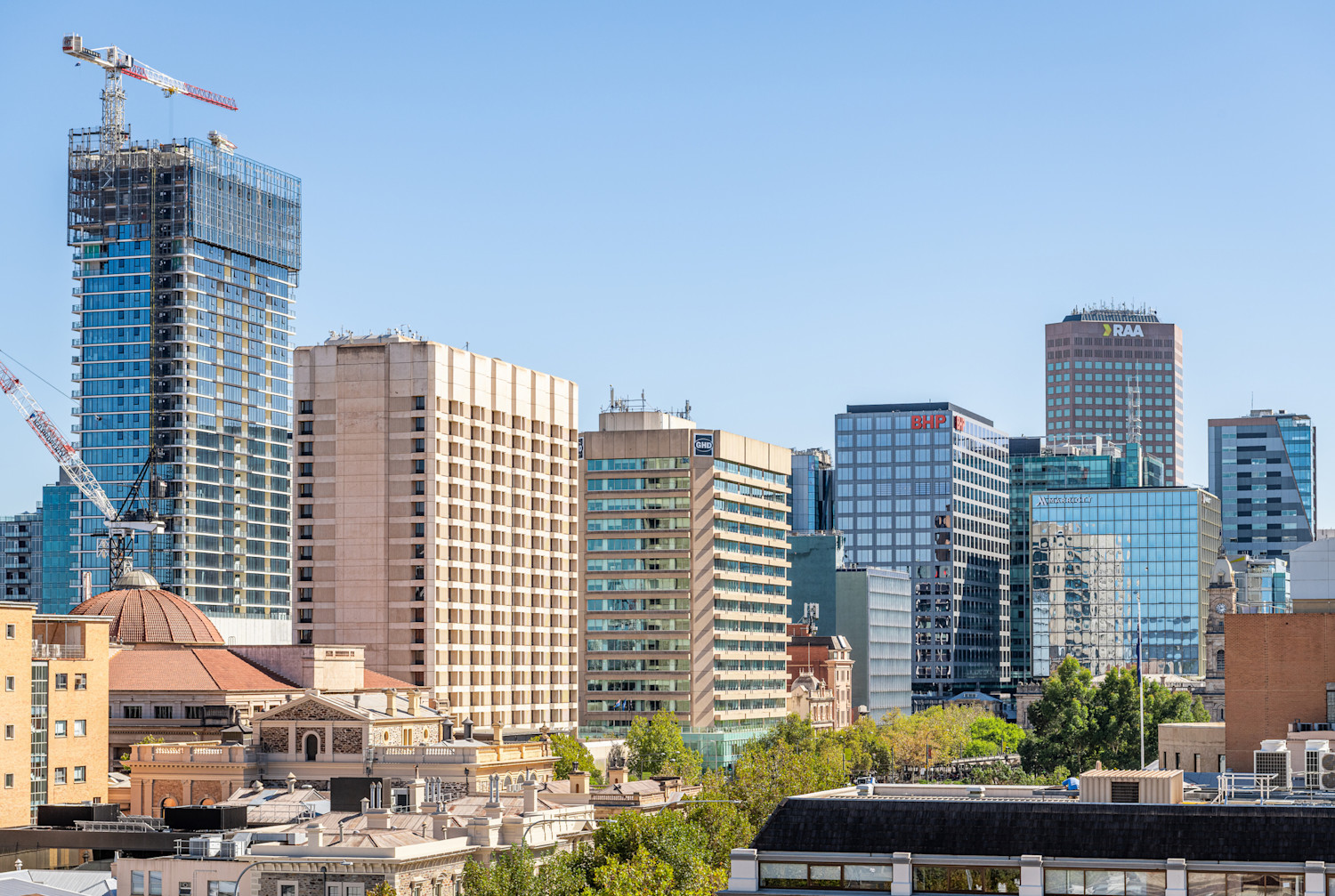
Adelaide recorded its 10th consecutive quarter of positive net absorption, with 500sq m taken up during the second quarter.
The Adelaide CBD vacancy rate tightened to 14.5 per cent, while prime gross effective rents increased 0.4 per cent over the quarter.
Perth’s CBD recorded 4,900sq m of positive net absorption, reducing vacancy to 16 per cent during the quarter.
Leasing activity was strongest among mining, public administration and services tenants, reflecting the composition of the Western Australian economy.
Canberra recorded a relatively stable result, with 800sq m of negative net absorption and vacancy holding at 10.5 per cent.
Montague said office markets had continued to navigate a volatile economic environment, with most CBD locations recording signs of expansion.
“The next 18 months will be heavily influenced by business conditions and lease expiry will remain a catalyst of market activity,” he said.
The office development pipeline continues to contract nationally, with JLL warning few projects are likely to move from approval to construction over the next 18 months.





