ResidentialLindsay SaundersThu 12 Nov 26
Investor Lending Records Sharpest Fall as Housing Finance Retreats

Australia’s property investment market has recorded its sharpest quarterly contraction on record, with new investor lending plunging 30.6 per cent as industry groups warn of mounting risks to housing construction and supply.
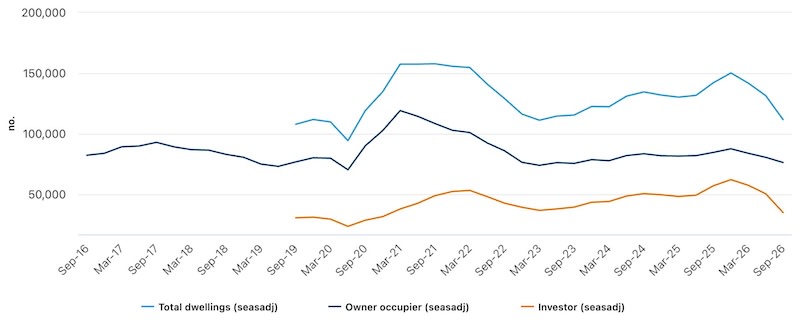
Australian Bureau of Statistics (ABS) figures for the September quarter show the number of new housing loans to investors fell to 35,301, down from 50,845 in the June quarter.
The value of investor lending fell 32.3 per cent to $24.7 billion, the third consecutive quarterly decline and the largest fall since the series began.
The figures are a sharp reversal from late 2025, when annual growth in the number of new investor loans reached 24.9 per cent. By September 2026, it had fallen to -38.5 per cent.
The retreat was also considerably deeper than the downturn in owner-occupier lending, with new loans to people buying homes to live in falling 5.3 per cent over the quarter.
Overall, the number of new housing loans fell 15 per cent to 111,878, while their combined value dropped 15.5 per cent to $81.2 billion — the largest quarterly decline since the ABS series began in September 2002.
ABS head of finance statistics Dr Mish Tan said the investor downturn was being driven by more than higher borrowing costs.
“While lending activity fell across all borrower types in the September quarter, the decline was sharpest for investors,” she said.
“Our data suggests that investor activity is being influenced by factors beyond increasing borrowing costs, including the potential impacts of tax changes and expectations of lower house prices.”
Tell ’em they’re dreaming...
Property Council of Australia chief executive Mike Zorbas said the figures raised serious questions about who would finance new housing if investors continued to retreat.
“Tell ‘em they’re dreaming. Who does the Albanese Government think is going to finance new home construction, including the rental homes Australians need?” he said.
“Investors account for around half of buyers in new apartment projects. Their off-the-plan purchases help developers secure the construction finance needed to get homes built.
“Without enough pre-sales, an apartment project fails to secure finance. That puts the entire development at risk, including the homes first homebuyers and other owner-occupiers want to buy.”
Zorbas called on the Federal Government to reconsider its changes to capital gains tax, negative gearing and trust taxation, arguing they were undermining investment in new housing.
The Urban Development Institute of Australia (UDIA) has also warned that restrictions on self-managed superannuation fund borrowing could further weaken investment in newly built homes.
Number of new loan commitments for homes
UDIA national president Oscar Stanley said the proposed restrictions risked removing a significant source of funding from the housing market.
“You cannot solve a housing supply crisis by cutting off investment in new homes. UDIA is calling for a specific exemption for new housing from the proposed SMSF borrowing restrictions,” he said.
The institute has estimated that up to $8.7 billion in property investment could be affected annually, based on Treasury figures showing about 8700 SMSFs entered new limited recourse borrowing arrangements in 2023–24.
Stanley said the institute was already hearing concerns about buyer confidence across its national membership.
“We are hearing from our broad UDIA membership across Australia that buyer confidence has dissipated, reflected in recent updates from major developers including Stockland and Mirvac, which have both reported significant declines in residential sales,” he said.
Master Builders Australia chief executive Denita Wawn also warned the figures could signal further deterioration in housing investment.
Speaking at the National Press Club on November 11, Wawn said the data reinforced the industry’s concerns about the Federal Government’s housing tax reforms.
“I hate to say it, but we were right … We called it out, a decline in investment in housing, whether it’s owner occupiers or investors, at a time when we can least afford it,” she said.
“We only think this is the start. It’s going to get worse.”
Shift will improve owner-occupier access
The Federal Government has defended its tax changes, arguing the shift away from property investors will improve access to housing for owner-occupiers and first-home buyers.
Housing Minister Clare O’Neil said the latest figures showed the intended shift in the market.
“We’ve had a housing market geared towards investors for a generation, and where did it get us? Plummeting home ownership, out-of-control house price increases, and a generation losing hope,” she told media.
“These numbers show the balance is shifting back towards Australians who are buying a home to live in, and especially to our first home buyers.”
However, first-home buyer lending also weakened during the September quarter, with new commitments falling 8.6 per cent, following a 4.4 per cent decline in the previous quarter.
The number of loans to first-home buyers was 12.3 per cent lower than a year earlier.