
ConstructionLeon Della BoscaWed 07 Oct 26
HIA Tallies $11bn Tax Cost of Two-Year Housing Accord Shortfall

Governments have forgone an estimated $11 billion in stamp duty and GST in two years.
That is the wash-up from a Housing Industry Association (HIA) analysis into the flagging home building rates as the nation falls behind its National Housing Accord target.
Australian Bureau of Statistics (ABS) building activity data released on October 7 covers the first two full years of the Accord, which aims to deliver 1.2 million homes by June, 2029.
Commencements over that period were 94,980 short of the pace required, according to HIA economists.
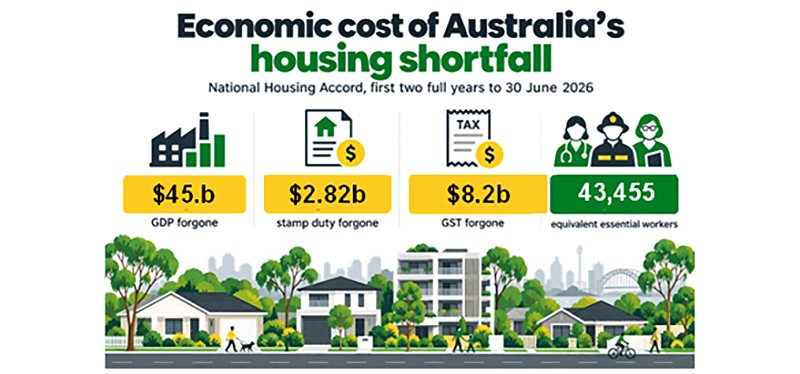
The HIA estimates put the uncollected revenue at $2.8 billion in stamp duty and $8.2 billion in GST, based on state and territory tax regimes.
Homes not started represent $45 billion in lost economic activity and housing for a potential 242,160 people, according to the industry body.
HIA managing director Jocelyn Martin said the data demonstrated “how much government revenue the sector generates between these two sources alone”.
“Rather than continue the trend to tax housing production more as a means to source more revenue for governments, this highlights the need to enact policy settings that support more housing delivery and therefore funding of more community services,” Martin said.
“New housing is revenue positive to government, whereas additional taxation as we saw in this year’s Federal budget will only serve to reduce supply.”
Had the targets been met, by HIA estimates, the extra tax revenue could have funded the equivalent of 43,455 essential workers over the two years.
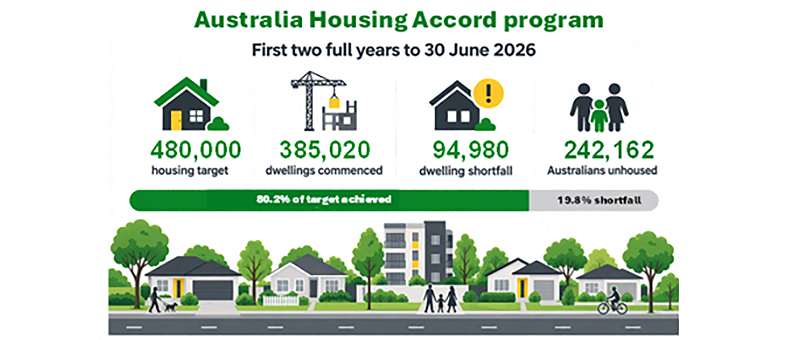
Starts did improve in the second year.
ABS figures show 204,502 homes were commenced in 2025-26, up from 180,518 a year earlier.
Completions totalled 355,817 across the two years, compared with 352,463 in the previous two and 124,183 short of the 480,000 needed to stay on track.
Reaching the target would now require 281,395 completions a year for the final three years of the Accord, according to Urban Taskforce chief executive Tom Forrest.
“The question now is: will the planning reforms that have been driven by state governments around the nation outweigh the impact of interest rate rises, dreadful productivity, labour supply shortages and declining property values?” Forrest said.
Detached housing led the charge.
After a decline in the March quarter, the latest ABS data shows total commencements rose 7 per cent in the June quarter to 52,201 in seasonally adjusted terms, with private sector houses up 11.6 per cent to 31,707.
Private sector apartment and townhouse starts, which the ABS classes as ‘other residential’, slipped 0.1 per cent to 19,126 after a 20.6 per cent fall in the March quarter.
Apartment and townhouse completions rose 13.9 per cent over the quarter to 19,018 and were 58.6 per cent higher than a year earlier.
Victoria completed the most homes at 112,599, down from more than 118,000 in the prior two years.
NSW followed with 91,954, below its earlier 95,303.
Queensland added 68,694, Western Australia 42,189 and South Australia 26,625, with gains in those three states offsetting the falls in the two largest.
Both NSW and Victoria would be “more vulnerable” to a construction slowdown because their recoveries had been more tentative, HIA senior economist Tom Devitt told media.
A record 248,733 homes were under construction in the June quarter, of which 95,447 were houses, ABS data shows. Total building work done rose 1.1 per cent to $45.8 billion, including $9.9 billion of new apartment and townhouse work.
June quarter improvement was more a reflection of approvals and sales made in 2025 than of current conditions, Martin said, with Budget changes to housing taxation and this year’s interest rate rises not yet captured.
HIA expects the effects of these to show in 2027.
Approvals have already softened, according to the ABS, with total approvals falling 6.1 per cent in August and apartment approvals down 21.2 per cent.
“With headwinds of potentially further interest rate rises and uncertainty caused by international events, this reinforces the need for governments and other policymakers to reduce the costs of land and housing if Australia is to meet its long-term housing needs,” Martin said.