
Sponsored ContentPartner ContentThu 10 Sep 26
GemLife’s Patented Apartment Solution to Land Lease Space Problem

Land lease has been one of Australia’s fastest-growing residential property sectors, but its traditional development model has relied on a scarce resource: large, flat, relatively cheap greenfield or broadacre land.
As competition for those sites intensifies, GemLife founder Adrian Puljich believes the next phase of the sector’s growth will depend on operators rethinking density, design and location altogether.
The Gold Coast-based developer and operator has secured a patented construction method for land lease apartments to be built vertically, while still complying with the legislative requirement that manufactured homes remain movable.
“The traditional land lease model needs a significant amount of land and, as the sector grows, competition for suitable sites is only going to increase,” Puljich told The Urban Developer.
“We knew that if we wanted to bring the model into more established locations, we had to find a way to rethink density without losing what makes land lease attractive in the first place.”
Gemlife spent more than a decade researching and developing a solution to the requirement for homes to remain movable.
“The patent is the culmination of that work and gives us a completely different way of thinking about the types of sites on which a land lease community could potentially be developed,” Puljich said.
Under the system, each apartment building comprises a permanent structural core and frame, with individual apartment modules of up to 200sq m designed to be removable rather than fixed in place.
The building facade is engineered for disassembly, so the modules can be extracted if required, without ever looking temporary.
This model will make its first appearance at GemLife Currumbin Waters, a $500-million community planned for Galleon Way on the southern Gold Coast.
Approved in late 2024, the 13.854ha site will comprise 215 apartments across eight residential buildings, seven of three levels and one of four, alongside a separate country club.
Around 70 per cent of the site has been set aside for green open space, including 7.7ha to be transferred to council as protected public open space.
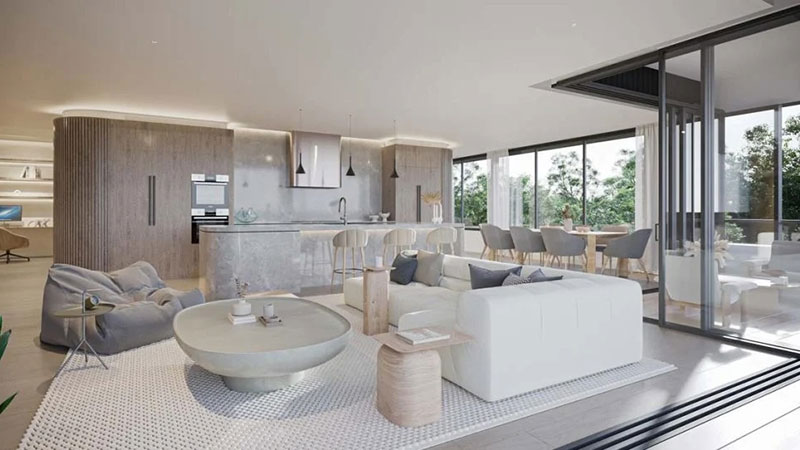
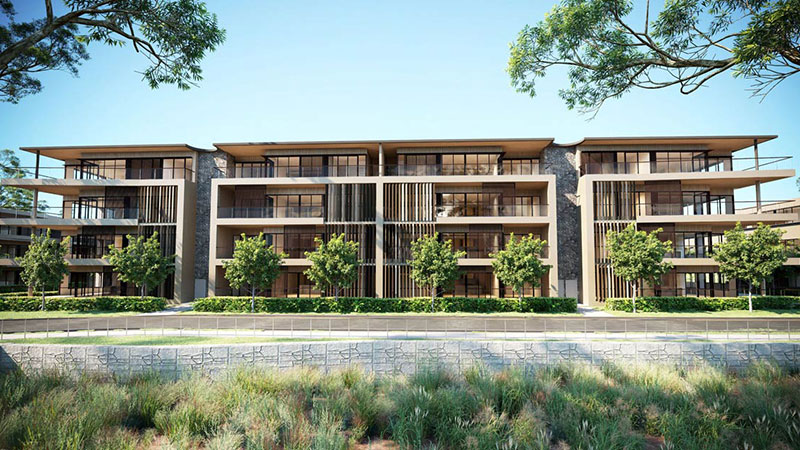
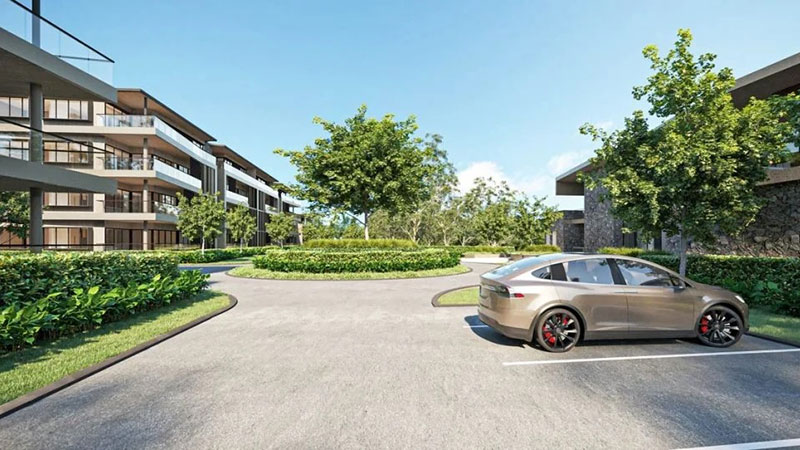
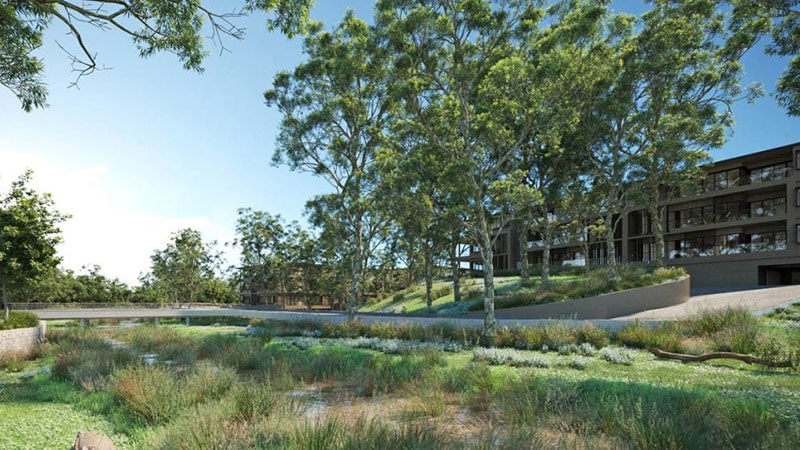
1 of 4
GemLife worked with Brisbane-based MAS Architecture to refine the design, with final enhancements currently before Gold Coast City Council.
External works are under way, with market launch and residential construction due to commence in 2027.
For an industry watching land supply tighten and competition for suitable sites grow, GemLife offers a case study in how a traditionally low-density, land-hungry model might be adapted for smaller, more constrained and increasingly urban sites.
“Currumbin Waters is the first application, but the bigger opportunity is what this methodology could allow us to consider in the future,” Puljich said.
“Our traditional communities have generally required sites of at least 15ha, whereas a vertical model could potentially work on around 4ha or less and on more constrained or contoured land.”
“That opens possibilities in locations we simply couldn’t have considered under the traditional model.
“We’re already looking at how the methodology could be applied to our next Gold Coast opportunity at Pimpama, as well as other sites where greater density could make land lease viable.”
According to GemLife head of multi residential and special projects Simon Fox, the patented methodology has the potential to scale beyond the low-rise buildings planned at Currumbin Waters, opening the door to higher-density and potentially high-rise applications over time.
A more compact building footprint can also free up more of the site for landscaping and green open space, while giving designers greater flexibility to orient buildings to optimise views, outlook and the relationship with the surrounding landscape, Fox said.
GemLife also sees vertical development as potentially broadening the appeal of land lease to downsizers who prefer apartment-style living.
“This isn’t simply about putting more homes on less land,” Fox said. “There is a cohort of downsizers who want the benefits of land lease living but prefer an apartment-style home.
“Vertical development gives us an opportunity to respond to that market in a way the traditional model hasn’t allowed.”
The patented approach reflects the continuing evolution of land lease, with vertical development creating new possibilities for site selection, residential design and construction while retaining the lifestyle and community benefits of the established model.
For a sector still shaking off its association with relocatable home parks, GemLife’s patented approach could lead to a more sophisticated offering, one built not just on lifestyle amenity, but on genuine engineering and design innovation.
With land supply tightening across the country, GemLife is betting on a future of land lease measured not in hectares, but in storeys.
The Urban Developer is proud to partner with GemLife to deliver this article to you. In doing so, we can continue to publish our daily news, information, insights and opinion to you, our valued readers.