ResidentialTaryn ParisThu 05 Nov 26
Boom, Bust, Repeat: Gold Coast ‘Not Immune’ to Downturn

After more than five years of runaway growth, the Gold Coast is cooling faster than most of the country.
House values are down 4.6 per cent in three months, according to Herron Todd White chief economist Cameron Kusher.
He said properties were also taking twice as long to sell and vendors were discounting harder than in any capital city.
Speaking at the Herron Todd White South-East Queensland Property Overview Breakfast, Kusher said the Gold Coast had been going “absolutely gangbusters” for five or six years, but conditions had shifted quickly.
“Things have certainly started to change and are changing quite quickly,” he said.
For anyone trying to time a purchase, Kusher said it was a hard call. “It’s very hard to pick the bottom of a housing market,” he said. “You won’t know that the housing market’s bottomed probably until about five months after it’s happened.”
The Gold Coast, he said, “is not immune to the downturn”.
Values peaked in May, sharp slide since
Data to September shows Gold Coast house values were down 4.6 per cent over the past three months and unit values were down 1.8 per cent.
Kusher said the had market peaked in May, and values had fallen by more than 1 per cent a month over the past quarter. The drop was steepest at the more expensive end.
Median house and unit prices Gold Coast
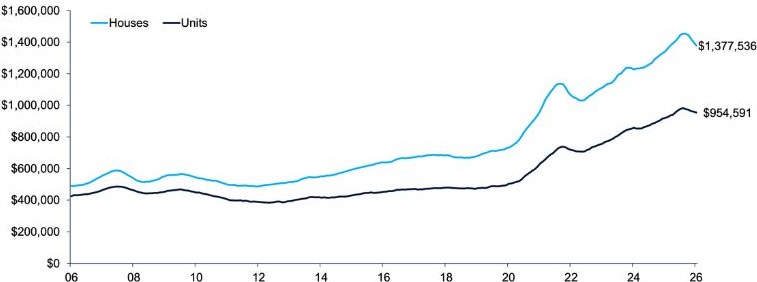
Annual growth is still positive, at 2.8 per cent for houses and 3.7 per cent for units. But Kusher said that “only looks to be heading in one direction at the moment”.
The slide followed a huge run-up. The typical Gold Coast house is now about $1.4 million, higher than every capital city except Sydney, while the typical unit is almost $1 million.
He said the Gold Coast, particularly for housing, was falling faster than most other markets. People thought the city had escaped its boom-and-bust past, he said, but “that’s proving not to be the case”.
Sellers wait, buyers wait
Sales activity is cooling alongside values.
Kusher said Brisbane sales volumes over the past three months were 26 per cent below the same period last year, and the Gold Coast was seeing a similar pattern. He said agents reported fewer open inspections and fewer offers.
Many would-be buyers, he said, were holding off, expecting lower prices in the next six months.
Sellers are digging in too. New listings have trended higher from a low base, but Kusher said many owners were reluctant to list unless they had to. With sales slowing, total listings have still drifted higher, though not to historically high levels.
The result is a longer wait to sell.
Gold Coast units were taking about 53 days on market, against about 23 days a year earlier this year.
“There’s an awful lot of properties that are just not selling,” he said, with some sellers unwilling to adjust their price expectations.
Discounting hits a high
But vendor discounting is running at 6.1 per cent for houses and 5.3 per cent for units on the Gold Coast, higher than in any capital city.
“There’s clearly people who are motivated to sell, but they’re having to drop their prices quite substantially on the Gold Coast at the moment in order to get those properties sold,” Kusher said.
He said the falls were creating openings for upgraders.
“More expensive properties are falling more than the cheaper ones,” he said. “You probably won’t get as much for your property, but that property you’re buying is going to be at a larger discount.”
Developers pull back
The slowdown is flowing into the pipeline. Gold Coast approvals for non-house homes were tracking well below recent years, and Kusher said high construction costs, high land costs and debt servicing challenges were hurting feasibility.
“We are probably going to see a pullback in new apartment approvals,” he said, forecasting fewer apartment and house project launches in the next few years.
The ultra-luxury end is the exception. Kusher said buyers paying $10 million to $20 million for new apartments were “not really impacted by higher interest rates”.
He said the supply drought would eventually push prices back up.
“The lack of new housing supply over the longer term will put price pressures back on the market,” he said. In the short to medium term, though, he expected values to keep falling.