

Sponsored ContentPartner ContentTue 18 Aug 26
Deal Structures Turning Landowners into Development Partners

Land acquisition has become one of the most contested functions in South-East Queensland property development, with off-market sites disappearing faster than most operators can assess them and on-market campaigns compressing decision windows to days.
For developers without deep local networks and real-time feasibility capability, competing against well-resourced land bankers and major developers for the same sites is an increasingly difficult proposition.
Atrio Property built to close that gap
The firm operates as a full-service development partner for landowners and developers, offering acquisition, sales and marketing, and development management under one roof.
Owner and managing director Chris Hall said the model gives smaller operators access to the same capability that larger developers carry internally.
“A lot of people have to use multiple consultants when developing, whereas Atrio covers most of that in house,” he said. “They plug into us, and we can give them that capability.”
Local knowledge, live data
That capability starts well before any campaign goes live. Atrio tracks land sales across key corridors against projected price movements over a two-to-five-year horizon and draws on active project experience on the ground to keep cost data current.
Long-standing relationships with landowners, agents and consultants give the firm early access to off-market opportunities, often before a site reaches a broader market.
“What you know and who you know is really big in acquisition,” Hall said.
Atrio reviews and filters a significant volume of opportunities each week through those networks alone.
Where sites do go to market, Atrio’s knowledge advantage becomes a timing advantage. Competitive campaigns sometimes give buyers no more than a week to place a credible offer.
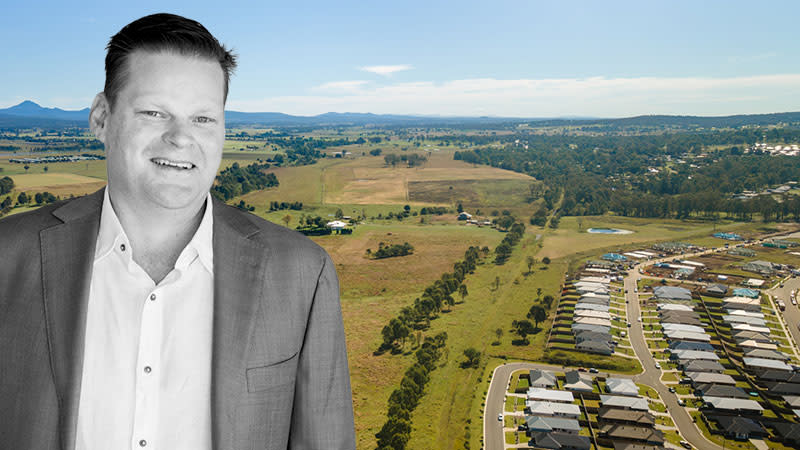
“Our best success has come from being embedded there for so many years,” Hall said. “That’s not something you can replicate quickly.”
The Western Corridor west of Brisbane, from Walloon towards Rosewood, is where Atrio is most active and where Hall sees the strongest near-term opportunity for small to medium operators.
Council is targeting up to 50,000 new homes in the corridor, well above current planning benchmarks, but fragmented land ownership and infrastructure constraints mean navigating relationships with council, Economic Development Queensland and infrastructure providers is essential.
“Someone coming in from Sydney or Melbourne would find it difficult to navigate this region,” Hall said. “The planning framework is different and relationships are key to success.”
The team works through environmental and planning constraints, which Hall said is increasingly valuable as more sites come to market carrying complex overlays.
“Risk is just another word for cost,” he said. “We make sure that’s allowed for in the feasibility and worked through during delivery.”
A different kind of deal
Atrio’s acquisition capability is built around developer outcomes, Hall said the firm’s most distinctive offering may be what it can do for landowners who have never considered an alternative to a straight sale.
The firm’s approach to deals sometimes allows landowners to retain their interest through the development process, receiving payment at final settlements rather than via a lump-sum sale, with capital gains tax advantages along the way.
For developers and capital partners, the structure removes substantial upfront costs before a project generates a return, significantly improving the internal rate of return.
“We’re not looking for a listing, and we’re not a single developer looking to buy a site,” Hall said. “We come in as a development partner, and we try to create win-win situations.”
The Urban Developer is proud to partner with Atrio to deliver this article to you. In doing so, we can continue to publish our daily news, information, insights and opinion to you, our valued readers.





