
If you’re ready to make depreciation part of your sales strategy, get a free marketing report for your next development or learn more about the Referral Program.
Sponsored ContentPartner ContentWed 07 Oct 26
How Developers Can Use Depreciation to Widen Their Buyer Pool

Affordability dominates almost every conversation about Australian housing right now, yet one of the most effective levers available to developers remains largely untouched.
Tax depreciation, long treated as an accounting afterthought, is increasingly being recognised as a genuine tool for improving purchaser affordability without discounting a single dollar off the sale price.
Washington Brown chief executive Tyron Hyde said the opportunity has grown since the Australian Taxation Office overhauled depreciation rules in 2017, and further again after the 2026 Federal Budget’s proposed changes to negative gearing, creating a divide between brand new and secondhand property.
“It’s never been a better time for property developers, in terms of tax advantages, to separate themselves from the secondhand crowd,” Hyde says.
Under current rules, an investor can claim depreciation on plant and equipment included within a property, items such as dishwashers, carpet and air conditioning, but only if a property is new.
The moment it is resold, that entitlement disappears, leaving only the building allowance claimable. That difference will widen further from July 1, 2027 under the government’s new negative-gearing rules.
Investors who bought secondhand property after May 12, 2026 will generally no longer be able to access negative gearing, while qualifying new property will.
“That’s a huge difference for an investor. We’re talking around $20,000 in the first year as a deduction,” Hyde says.

▲ Hyde said “a marketing report is the most powerful tool a developer can have”.
A cash flow comparison prepared by Washington Brown across two ownership scenarios—a brand new unit and a unit built in 2016, both purchased after the new negative gearing rules take effect—shows the weekly cash flow position for an investor improves substantially with new stock.
The report shows once depreciation deductions and the resulting tax benefit are factored in, a brand new purchase can leave an investor with a weekly cash flow position of +$10, compared with -$438 for the 10-year-old property.
This gap comes almost entirely from the plant and equipment component only available on new property, as well as the new limits on negative gearing. For a purchaser, that translates directly into affordability.
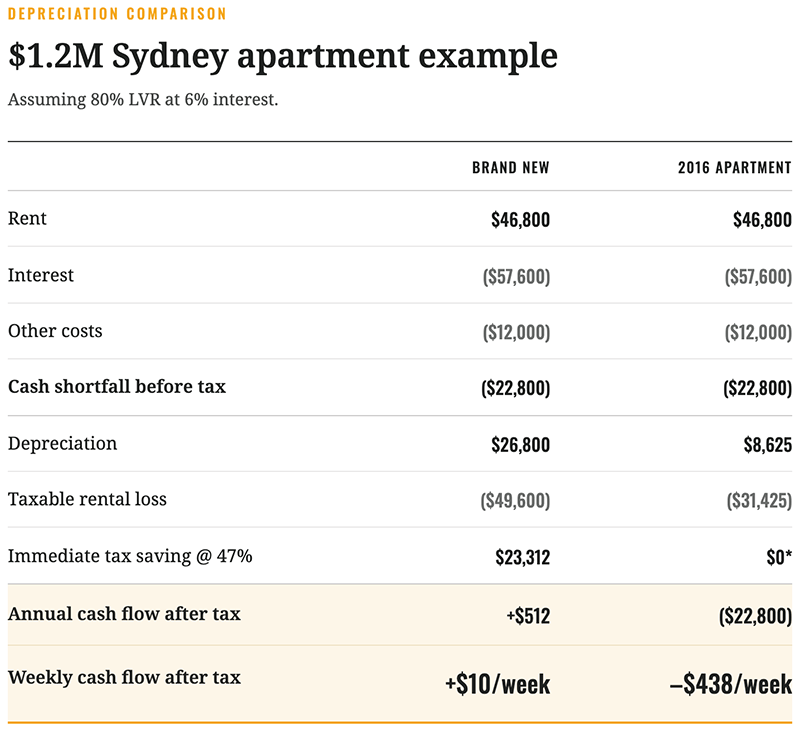
▲ *Under the proposed changes, the ‘taxable rental loss’ will be carried forward to future years if there is no current positive residential property income to offset.
“That can make a meaningful difference to an investor’s monthly cash flow and make the purchase more affordable to hold,” Hyde said.
Hyde said claiming depreciation is no different to claiming wear and tear on a work vehicle against taxable income.
“There’s nothing different about doing that with property,” he said.
There is also a compliance dimension developers may not be aware of.
Under tax laws, in accordance with TR97/25, developers must give purchasers the construction cost information they need to work out their Division 43 building allowance.
It is a legal requirement, not just good practice, and Hyde said it is easy to satisfy as part of a broader depreciation strategy rather than as a separate task.
Where marketing reports come in
Rather than a standard depreciation schedule prepared after settlement, a marketing report is built during the sales process, using projected construction costs and indicative sale prices to estimate deductions.
A typical report breaks this down over a 10-year period, using diminishing value and prime cost methods, giving developers a concrete figure to put in front of prospective buyers rather than a vague promise of tax benefits.

▲ Washington Brown has partnered with Meriton since 1998, providing depreciation reports across its residential projects.
Used well, Hyde said, the report can be part of the sales conversation from the outset rather than handed over at settlement.
Developers who use it at presales and settlement events tend to see stronger uptake, and purchasers who have a good first experience with depreciation are more likely to buy again.
Beyond individual reports, Washington Brown’s Referral Program gives developers an ongoing relationship with a specialist tax depreciation firm rather than a one-off transaction.
The firm has worked with Meriton since 1998 and counts more than 3000 referral partners nationwide, with a 4.9 out of 5 rating on Trustpilot from more than 1200 reviews.
Developers provide project details, including construction costs, floor plans and indicative pricing, and receive a report they can include with their marketing collateral.
The first marketing report is free*, ongoing free reports are available to Platinum-tier partners, and bulk orders across a development can attract discounts of up to 75 per cent off the standard rate.
With affordability pressures unlikely to ease quickly, depreciation should become a more prominent part of how developers pitch new stock, Hyde said.
“The developer can go to market highlighting the potential claim on a given apartment and show more prospective buyers that the purchase is within reach,” he said.
*Available for developments with 20 or more units and an average sale price under $2 million per unit.
The Urban Developer is proud to partner with Washington Brown to deliver this article to you. In doing so, we can continue to publish our daily news, information, insights and opinion to you, our valued readers.