
Sponsored ContentPartner ContentWed 23 Sep 26
Stack Modular Reveals the MMC Feasibility Sweet Spot

Modular construction has largely won the argument on speed. Ask any developer and they will concede that offsite builds move faster than traditional construction.
Cost is where the scepticism remains, and for good reason. Most modular projects in Australia are in the low-rise, high-volume category, where quality expectations and contractor tiers are lower than a typical mid or highrise build.
Judged against that yardstick, modular rarely looks like the cheaper option.
Stack Modular is a privately owned Canadian company with 17 years in offsite construction.
Its structural steel frame system, engineered around hot-rolled steel posts and beams in a welded configuration, is built specifically for mid and highrise delivery, with a stacking capability of up to 40 storeys when paired with a concrete core.
Stack Modular director of global sales Stuart Marshall said the economics made sense once the comparison shifts to the right asset class.
“Our modules don’t care whether it’s building a single storey or a 40-storey,” Marshall told The Urban Developer.
“The structure cost is stable. Once you get to around six storeys plus, that’s where it starts to balance out, and by 20 to 25 storeys, it becomes more cost effective than a traditional build, before you even factor in delivery and time savings.”
The case for the missing middle
Rather than chasing headline height, Stack Modular is targeting what it calls the missing middle: the six to 26-storey band where developers get scale benefits without the perceived risk of pushing into full highrise territory.
“Australia has some amazing, well-respected modular companies doing great work in the low-rise sector, and some working on highrise projects now, too,” Marshall said. “But there’s a gap in the market, which is mid-rise, and that’s where we see the future for modular.”
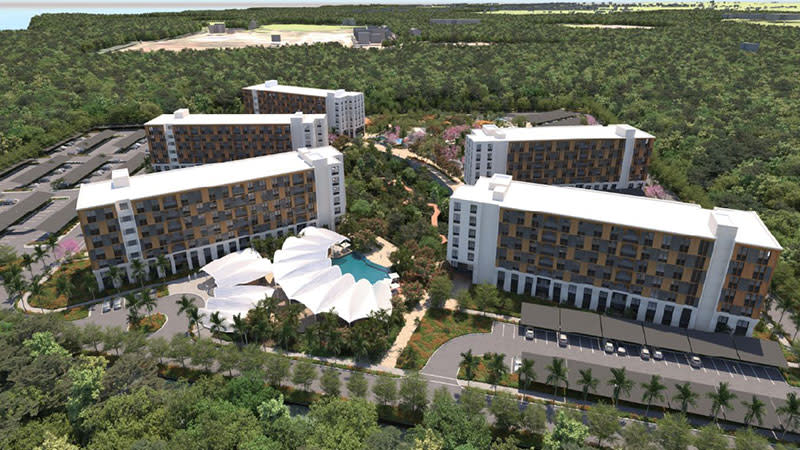
The system’s point-loaded structure, where load transfers through four corner posts rather than full walls, allows modules of varying configurations to be combined and stacked with more design flexibility than standardised, single-size offshore products.
That flexibility is well suited to build-to-rent, Marshall said, which is an asset class he expects to become the sector’s biggest growth area locally, following trends already seen in Europe.
Certainty more valuable than cost
Marshall’s pitch to developers sidesteps unit cost and focuses on certainty, which is the metric he said protects a project’s margin.
Because Stack Modular is vertically integrated, manufacturing its own modules and chartering its own shipping rather than relying on third parties, it can lock in pricing before construction begins.
A 200-module project quoted at $20 million is contracted and delivered at $20 million, Marshall said, “without the variations that typically erode budgets once a traditional build is underway”.
“The more detailed design work done upfront, the more fixed your cost is,” he said.
Skimping on design time is where developers tend to lose certainty, opening the project up to the cost creep modular is meant to avoid.
And certainty comes with a trade-off developers need to plan for, he said.
Because steel and fit-out materials must be procured well ahead of delivery, modular payment schedules are more front-loaded than a traditional build, with significant capital required before groundworks even begin.
Marshall said getting funders comfortable with that earlier drawdown, rather than the cost itself, is usually the real hurdle.
Quality certainty is the harder variable for developers to assess upfront.
Stack Modular operates to Tier One quality standards, delivering the level of engineering, manufacturing, quality assurance and project controls expected on complex mid- and highrise developments.
Marshall said that distinction is often overlooked when developers compare modular suppliers on price alone.

He also said buyers often default to comparing suppliers on cost alone, without weighing up what is actually included in that price, from insurance and shipping through to the level of detailed design behind the numbers.
Backing the right partner
With Queensland’s Olympic pipeline and New South Wales’s early regulatory lead drawing growing developer interest, Stack Modular is focused on building its Australian footprint.
For a housing sector under sustained cost and delivery pressure, the case Marshall makes is less about modular being cheap, and more about it being trustworthy and predictable.
“You just want to be a trusted partner, somebody who’s been there, seen it, done it,” Marshall said.
“We just want developers to make the right choice when it comes to manufacturing supply, choosing people who can educate them and hold their hand through it, rather than just going for the cheapest return on investment they can get.
“Seventeen years in, we’ve made mistakes and learned from them. It’s not going to be a smooth ride for anybody, but working with someone experienced smooths that a lot more.”
The Urban Developer is proud to partner with Stack Modular to deliver this article to you. In doing so, we can continue to publish our daily news, information, insights and opinion to you, our valued readers.





