
Sponsored ContentPartner ContentWed 02 Sep 26
Solving the Buyer Confidence Gap in Off-the-Plan Sales

Housing delivery is not only a construction challenge. Keeping projects moving from approval to completion depends as much on transaction momentum as it does on what happens on site.
It’s no secret buyer confidence in the sector has weakened. Equifax research found that 78 per cent of Australians are concerned about insolvencies in the construction industry. Just over half are more concerned about builders failing to finish projects than they were a year prior.
Coupled with rising interest rates, cost of living pressures and tax policy changes, those concerns mean buyers are more cautious about managing their financial position throughout their buying journey, particularly where funds sit beyond their control for long periods.
In off-the-plan and house-and-land markets, build times often extend to two years or more. A standard 10 per cent deposit can mean $100,000 or more held in a developer’s trust account until settlement.
For buyers with the income and borrowing capacity to proceed, that cash requirement at exchange is often where the decision stalls.
The result is a narrower buyer pool at precisely the moment sales matter most. Pre-sales inform construction finance, support project viability and determine whether a development moves from approval to delivery.
When genuine buyers pause at exchange, projects carry that pressure through every phase that follows.
Traditional tactics like price reductions, stamp duty concessions and inclusion incentives are often rolled out to close deals. These erode margin and affect project profitability.
For developers and their financiers, reducing friction in the sales process without giving away margin is a worthy pursuit.

Deposit bonds offer a direct way to address this. Used in place of a cash deposit at exchange, a deposit bond is a financial guarantee issued to an eligible purchaser for a one-off fee.
It is underwritten by an insurer and assessed at application. The buyer keeps their capital in an offset, a savings account or across existing holdings for the full build period.
The developer gets the same protection as a cash deposit. If a buyer defaults, a claim can be made against the bond. The insurer pays out the developer and pursues recovery separately. There is no fee to the developer.
Investors with capital tied to existing assets, downsizers with equity locked in a family home, buyers wanting to upsize before selling—these are buyers with intent and financial means. Yet many face freeing up $100,000, $200,000 or more to exchange.
Removing that barrier, without cutting the price or adding incentives, gives sales teams a practical tool to convert interest into exchange and widen the pool of buyers who can confidently commit to a purchase.
Deposit Power has operated in the Australian market for more than 30 years. Its bonds are underwritten by HDI Global Specialty SE, rated AA– by S&P Global Ratings.
Terms extend to 66 months, covering most residential construction programs.
Deposit Power head of sales and distribution Nick Rumpff said getting more homes built also means getting more buyers confidently committed.
“As Australia asks more people to invest in new housing, we should be looking at every part of the transaction that can help qualified buyers feel confident to exchange and keep project sales momentum moving,” Rumpff said.
“We’ve seen what can happen when buyers are given another way to approach the deposit. At one development on Sydney’s Lower North Shore, 77 per cent of purchasers chose a deposit bond over providing the traditional cash deposit.
“That tells us there is real value in giving buyers greater flexibility at that critical moment of commitment.”
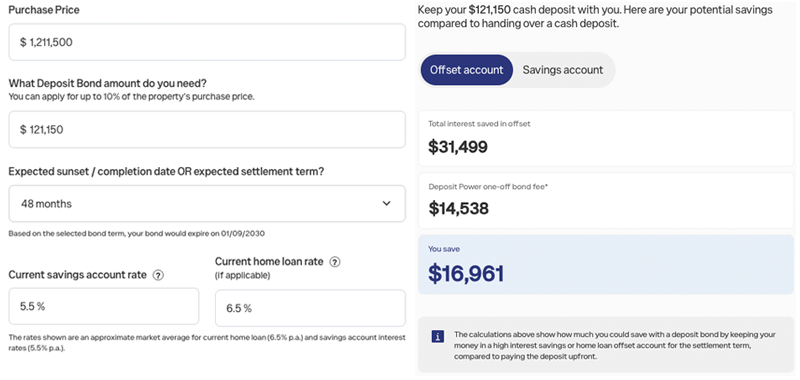
Sales teams can use Deposit Power’s savings calculator to help buyers model the benefit of keeping funds in an offset or high-interest account across the life of a bond.
This gives them a concrete way to weigh their deposit options, while giving sales teams a useful tool earlier in the sales process.
Where the pressures on project delivery are well known, the transaction side of housing supply—how readily genuine buyers can commit—deserves equal focus.
Talk to the Deposit Power team about integrating deposit bonds into your sales process, or model the financial benefit for your buyers with the Deposit Power savings calculator.
The Urban Developer is proud to partner with Deposit Power to deliver this article to you. In doing so, we can continue to publish our daily news, information, insights and opinion to you, our valued readers.