
ResidentialLindsay SaundersWed 25 Mar 26
Housing Supply Rises but Accord Targets Remain Elusive

Australia’s housing supply is steadily increasing, according to a new report, as the clock ticks on achieving the National Housing Accord target of 1.2 million new homes by June 2029.
In its first quarterly report, released on March 25, the National Housing Supply and Affordability Council said that across the country, quarterly building approvals and commencements had each risen by 17 per cent since the accord began, with 219,000 new homes completed over the first five quarters of the initiative.
Construction costs have fallen slightly in real terms, while build times have improved by around 10 per cent, supporting faster delivery of new homes, the report said.
In New South Wales, building approvals increased by 8 per cent over the past year, reflecting stronger development activity across the state.
Home completions rose 21 per cent, but modelling indicates that the state may not reach its share of the Accord target until June 2031, highlighting the scale of ongoing demand.
Victoria presents a mixed picture, with approvals declining by 1 per cent while completions rising 28 per cent over the year.
Despite the strong completion rate, the state is projected to meet its Accord housing share by the third quarter of 2029, with declining approvals posing a potential challenge to future progress.
Queensland is experiencing sustained growth, with building approvals rising 16 per cent and completions climbing 26 per cent, driven by ongoing demand and active development.
The state is forecast to achieve its housing share by September 2030.
Western Australia also showed strong growth—approvals were up 13 per cent and completions surged 29 per cent, indicating solid performance across multiple segments of the housing market.
Projections suggest the state will reach its housing target by September 2029, supported by steady activity in detached and higher-density developments.
How the state, territories are faring
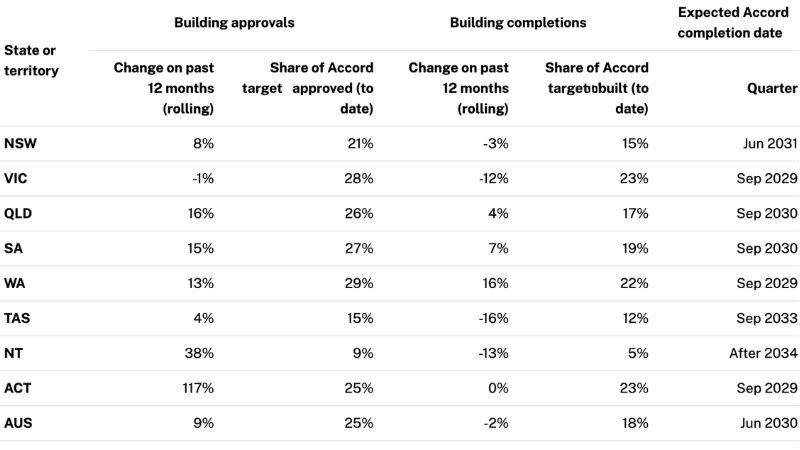
Smaller states and territories recorded moderate gains in approvals and completions, though their expected completion dates vary, with some trailing behind the larger states.
The Northern Territory had a significant 38 per cent increase in approvals but is still projected to meet its Accord target beyond 2034, highlighting the challenges of delivering sufficient housing in less populous regions.
Overall, the council said, each jurisdiction’s trajectory toward the Accord target is influenced by factors including local planning conditions, housing density trends, and the pace of construction, creating a diverse picture of progress across the country.
Council chair and former Mirvac chief executive Susan Lloyd-Hurwitz told media that the report highlighted the “tangible progress that has been made since the start of the Accord period and the continuing efforts by states and territories to increase the supply of housing”.
“Cost pressures, inflation, interest rate rises are all to the downside of where we think we are going.
“Getting the things that are approved built will be more challenging.”
Property Council chief executive Mike Zorbas said the data showed that housing targets improved state and territory approval performance, but post approval systems needed radical uplift.
“We are approving more homes, but getting fewer out of the ground,” Zorbas said.
“With the latest construction supply cost spikes around 30 per cent and supply chain disruption, we need to pull all the government levers to keep housing supply pumping.”
Zorbas warned international developments were already intensifying pressure across the construction sector.
“With conflict continuing in the Middle East, supply chain risks have landed on our doorstep,” he said.
“Supply chain cost shocks flow straight into feasibility and delay projects that are already approved.”
The targets for each state and territory are based on their share of the national population in December 2022.
NSW leads with 376,000, then Victoria (306,000), Queensland (246,000), WA (129,000), SA (84,000), Tasmania (26,000), the ACT (21,000) and the NT (11,000).