Sponsored ContentPartner ContentThu 12 Nov 26
The Payment Gap: Know When to Keep Funding—And When to Stop

What’s worse: overpaying or allowing the right amount to fund another development?
Every month, construction lenders go to great lengths to ensure that they aren’t paying for work that hasn’t yet been performed.
Monthly drawdowns are contingent on independent verification by the QS that progress onsite supports what has been claimed. Logical.
But construction lending governance currently stops at progress certification; we verify that work has been done, but not that the funds advanced against that work have actually been used to pay for it.
Even Cost to Complete, the fundamental metric in construction funding risk reporting, is only as reliable as the ‘stat decs’ behind it.
Cost to Complete forecasts ignore unpaid claims
Where certified progress remains unpaid, the expected link between drawdown and Cost to Complete is broken. The loan increases and reported Cost to Complete reduces accordingly, but the project’s actual remaining cash obligations remain unchanged.
Without oversight, progress payments can “leak” into other developments undetected for months. But Cost to Complete still says your project is on budget, so the lender continues to fund it.
By the time a cash shortfall becomes apparent, expected returns are already being eroded, with developer equity and lender capital at risk.
The payment “blind spot” is a known, systemic weakness in construction lending governance, considered largely unavoidable without taking on payment obligations directly. That’s no longer the case.
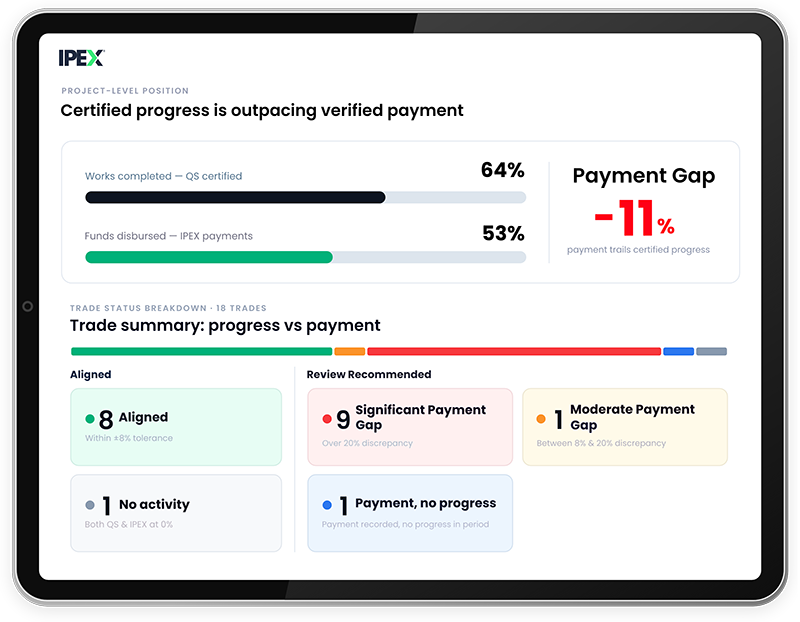
QS verifies progress, IPEX verifies payment
Developers and lenders can now apply the same fundamental governance principle to both the work completed and the funds advanced against that work.
Any gap between certified progress and verified payment can be quantified and actively managed with IPEX.
Where the payment position falls outside defined tolerances, the lender can stop or condition further funding; issues can be addressed or, at the very least, contained before they compound into a larger capital exposure.
Missing metric in construction lending risk monitoring
Multiple lenders already require borrowers to submit IPEX payment data as a condition of continued funding. The new AI-powered Payment Verification Report takes risk monitoring a step further.
Progress and payment data can now be automatically cross-checked as part of the monthly drawdown approval process. The report provides:
independent verification of the payment status for each trade (certified progress versus verified payment)
the ‘Payment Gap’: a single, cumulative measure of the difference between certified progress and verified payments.
For example, if cumulative progress is certified at 64 per cent, but verified payments against that work sit at 53 per cent of total contract value, your project has a Payment Gap of 11 per cent; on a $10-million project, this represents a $1.1-million gap between the amount expected to flow through to subcontractors and suppliers versus what has actually been paid.
Payment Gap is designed to be diagnostic, not alarmist
A significant variance between certified progress and verified payment prompts investigation into the underlying reason.
Importantly, potential issues are surfaced monthly, allowing the developer and lender to distinguish legitimate timing issues or contract letting differences from matters that require remedial action.
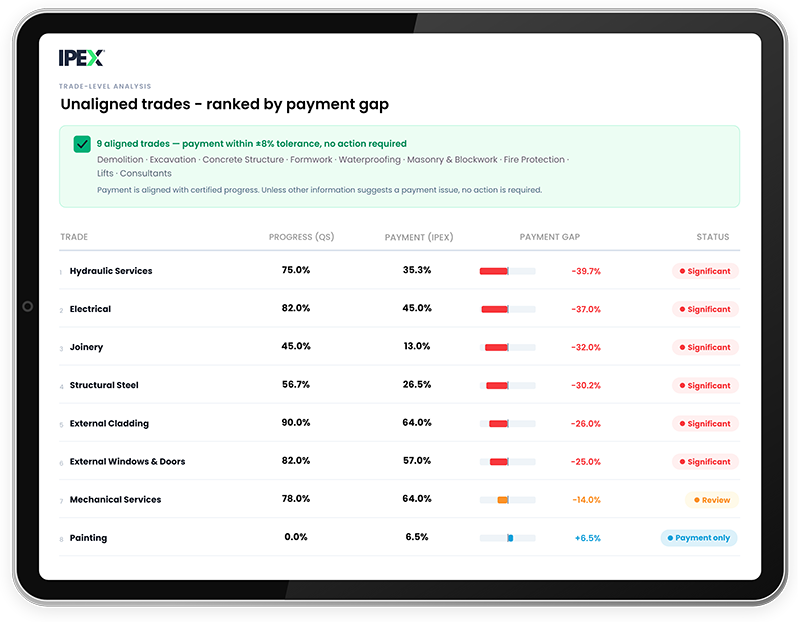
New standard in construction lending governance
You can’t remove all risk from construction lending, but exposure is magnified when governance only tracks funds as far as the builder.
Without payment verification, a project’s Payment Gap is a hidden source of exposure. IPEX transforms it into a manageable governance metric, allowing funding decisions to be made on actual data, not assumptions.
For lenders, the Payment Verification Report provides a simple monthly funding control: is the Payment Gap within tolerance? For developers, it provides the detail behind that number: which trades have been paid and which haven’t, the specific payment information you need to address emerging issues before they cost you money.
Financial governance isn’t complete until both the progress and payment stories align.
To see the Payment Verification Report in action, contact IPEX for a demo.
The Urban Developer is proud to partner with IPEX to deliver this article to you. In doing so, we can continue to publish our daily news, information, insights and opinion to you, our valued readers.