

InfrastructureLindsay SaundersThu 11 Jun 26
Australia’s Largest Electricity Transmission Project Powers Up

Australia’s largest electricity transmission project has been energised, a major milestone for the nation’s renewable energy transition after years of delays, contract failures and significant cost overruns.
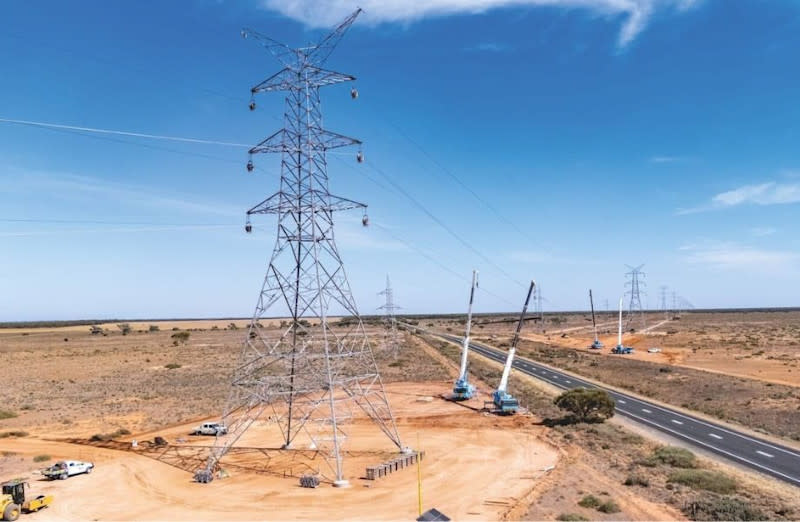
Project EnergyConnect, a 900km high-voltage interconnector linking the electricity grids of New South Wales, South Australia and Victoria, is a new pathway for renewable energy to flow between the three states.
The $4.1-billion project has been described as a critical piece of infrastructure for improving energy security, reducing wholesale electricity costs and supporting the shift away from coal-fired generation.
The energisation was announced by transmission operator Transgrid, which said the project would play a key role in connecting renewable energy zones and strengthening the National Electricity Market.
Project EnergyConnect stretches from Wagga Wagga in NSW to Robertstown in South Australia, with a connection into Victoria at Red Cliffs.
The project includes more than 1500 transmission towers, multiple substations and hundreds of kilometres of new transmission infrastructure across regional Australia.
Project EnergyConnect was first conceived in 2016 when ElectraNet began exploring a new interstate transmission link between SA and NSW.
Construction completion was celebrated earlier this year by Transgrid and delivery partner Elecnor at the Dinawan Substation near Bundure in the Riverina, marking the end of one of the country’s most complex energy infrastructure builds.
The project has not been without challenges.
Originally approved in 2021 at a cost of around $2.3 billion, the NSW section is now expected to exceed $4 billion after a series of setbacks, including the collapse of the original engineering, procurement and construction contract, labour shortages, supply chain disruptions, inflationary pressures and severe weather events.
Speaking to media after the energisation, Transgrid chief executive Brett Redman acknowledged the difficulties encountered during delivery.
“It has not been easy,” Redman said.
“There have been a lot of challenges along the way but today represents a significant achievement for everyone involved in the project.”
The cost overruns have prompted scrutiny from regulators and major electricity users, with debate continuing over how additional project costs should be recovered.
Despite those challenges, energy market experts and governments have consistently maintained that the project is critical to Australia’s energy transition as ageing coal-fired power stations progressively retire and are replaced by renewable generation supported by storage and transmission infrastructure.
The Australian Energy Market Operator has repeatedly identified transmission delivery as one of the most important factors in ensuring a reliable and affordable transition to a low-emissions electricity system.
Once fully operational, EnergyConnect will allow electricity to flow more freely between NSW, SA and Victoria, helping to improve grid reliability, increase competition between generators and reduce the risk of supply shortages during periods of peak demand.
The project is also expected to unlock billions of dollars of new renewable energy investment by providing additional capacity for wind and solar developments across regional NSWand SA.
Transgrid estimates the interconnector will deliver close to $1 billion in net economic benefits over its lifetime through lower energy costs, improved reliability and greater access to renewable energy resources.
With the line now energised, the project enters its final testing and commissioning phase before reaching full operational capacity, creating a new backbone for Australia’s rapidly expanding renewable energy network and one of the most significant pieces of energy infrastructure delivered in the nation’s history.





