
ResidentialLindsay SaundersThu 22 Jan 26
Victorian Completions Plummet to 11-Year Low

Victorian building completions have fallen to an 11-year low with just 13,748 homes completed in the September 2025 quarter.
It is the lowest result for the quarter since 2014. Since then, Victoria’s population has grown by 1.2 million people, meaning homes are being delivered at the same pace as 11 years ago but for a population now 21 per cent greater.
Building starts in Victoria also declined over the quarter, down from 14,105 in June 2025 to 13,415 in September.
Starts increased in New South Wales, Queensland and South Australia.
Property Council Victoria deputy executive director Andrew Lowcock said the figures highlighted a concerning handbrake on the industry.
“Victoria has traditionally been ahead of the rest when it comes to building new homes, but the numbers show that we are at serious risk of falling behind,” Lowcock said.
He said a growing and complex web of property taxes, from increased land tax to the windfall gains tax and ‘the nation’s worst global investor taxes’, was scaring away investment and delaying new housing projects.
“The property council has been warning for years that these settings would drive future investment away and stall projects, and the data now makes that reality impossible to ignore,” Lowcock said.
“Victoria has the fastest-growing population in the country, but we’re building homes at 2014 levels. That mismatch is unsustainable.”
The NSW Government said three-quarters of that state’s 75,000 homes now under construction were thanks to its raft of reforms.
Meanwhile, NSW recorded its highest housing completion numbers in five years with 13,057 homes completed during the September quarter.
This was the highest quarter for the state since March 2021.
According to the ABS data, housing completions in NSW were trending up by 37 per cent for the quarter compared to the previous quarter.
Home starts were up 9 per cent year-on-year, reaching 12,887 for the September quarter—the highest since June 2023.
Total homes commenced by state, seasonally adjusted
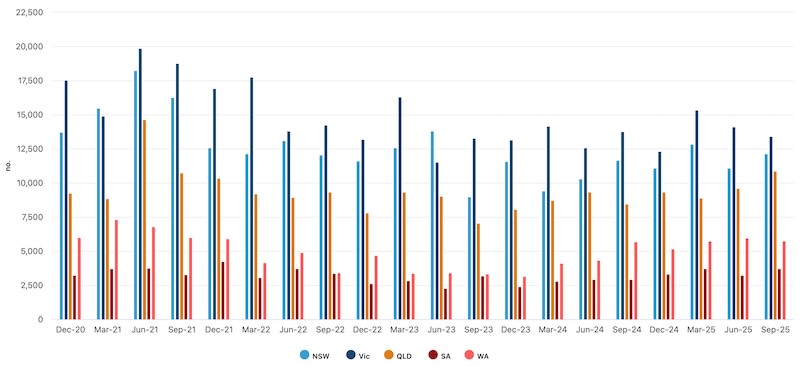
Nationally, building activity showed tentative signs of recovery in the quarter as home starts rose after a soft previous period.
Total home starts across the country increased 6.6 per cent in seasonally adjusted terms to 48,778 homes.
The lift was driven primarily by private sector housing, with new house starts rising 6.9 per cent to 28,485 homes.
Other private residential starts, including apartments and townhouses, also increased, climbing 3.5 per cent to 18,747 homes.
The rebound followed a decline in the June quarter, suggesting some stabilisation in construction momentum.
Despite the improvement nationally, starts remain well below levels required to meet longer-term housing supply targets.
The value of total building work done rose 3.8 per cent over the quarter to $43.2 billion.
Residential building activity accounted for most of the increase, reflecting stronger output on detached housing projects.
Non-residential construction activity remained uneven, continuing to weigh on overall sector performance.
Nationally, the number of homes under construction increased to 230,003.
High construction costs, labour shortages and financing pressures continue to affect delivery schedules across the industry.