

IndustryLindsay SaundersWed 25 Nov 26
Construction Work Jumps as Residential Activity Drives Growth
A rise nudging 10 per cent compared to a year ago was led by solid improvements in Australia’s two smallest states...

Australia’s construction sector recorded a rise in work done in the September quarter, with residential building activity leading growth as engineering construction declined.
Australian Bureau of Statistics (ABS) figures showed the value of total construction work done increased 0.9 per cent to $88.2 billion in the quarter, in seasonally adjusted terms.
Building work rose 2.4 per cent to $50 billion, while engineering construction fell 0.9 per cent to $38.3 billion.
Residential building work was the strongest contributor to the increase, climbing 3.1 per cent to $30.4 billion over the quarter.
Non-residential building work also increased, up 1.5 per cent to $19.6 billion.
Compared to the September quarter of 2025, total building work was up 9.6 per cent—a 9.3 per cent increase in residential activity and a 10.2 per cent rise in non-residential work.
Engineering construction was 1.3 per cent higher year-on-year.
The trend estimate, which smooths quarterly fluctuations, showed total construction work rising 2 per cent to $88.3 billion.
National Association of Women in Construction chief executive Cathryn Greville said that the data showed “an industry in good health”.
“What’s shifting is the mix. Over the past two years, building work has grown by around 17 per cent while engineering has barely moved, so homes and other buildings now make up a much bigger share of the industry,” Greville said.
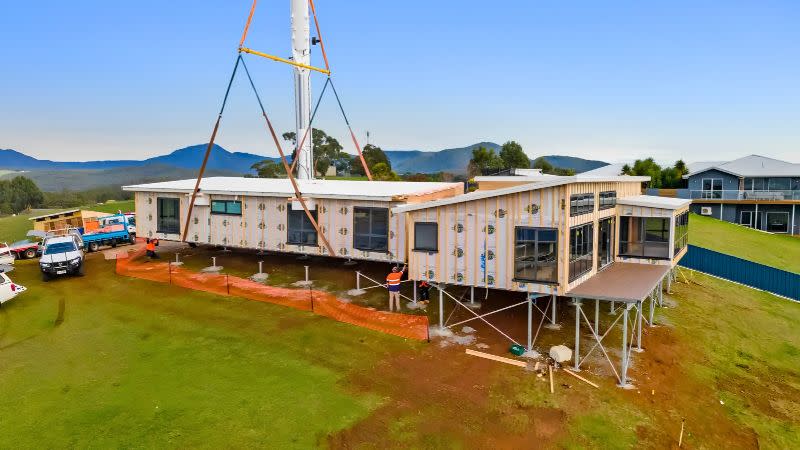
State and territory results were mixed, with the Australian Capital Territory recording the strongest quarterly growth, followed by Tasmania.
The ACT recorded a 19.5 per cent increase in construction work to $1.25 billion, while Tasmania rose 12.9 per cent to $1.36 billion.
South Australia increased 3.9 per cent to $6.13 billion and New South Wales rose 2.2 per cent to $25.9 billion.
“In a market the size of Canberra’s the quarterly numbers will always swing around, but the annual picture shows an industry that is growing again,” Greville said.
“NSW builders need to widen who they recruit, including women, who make up only around one in eight construction workers, and do far more to keep the people they already have.”
Victoria recorded a 0.8 per cent increase to $20.9 billion.
Queensland was down 1.2 per cent to $17.8 billion, while Western Australia fell 1.9 per cent to $13.9 billion.
The Northern Territory increased 5.5 per cent to $947 million.
Over the year, Tasmania recorded the strongest growth in total construction work, up 17.3 per cent, followed by South Australia at 11.3 per cent and New South Wales at 8.1 per cent.
The ABS said the preliminary estimates were based on a response rate of about 80 per cent of surveyed construction entities and were subject to revision when updated building and engineering construction data are released on January 13, 2027.
The figures measure the volume of construction work undertaken, rather than the nominal value of contracts, with estimates presented in chain volume measures.
Oxford Economics Australia head of Property and Building Forecasting Timothy Hibbert expects residential construction momentum to continue into 2027 as demand generated by earlier interest rate cuts, price growth and government support flows through to building activity.
Attached homes drove September-quarter growth, rising 5.3 per cent, supported by luxury apartment projects in South-East Queensland.
However, Hibbert warned higher interest rates, tax changes, elevated construction costs and tighter credit would weigh on development feasibility later in the decade. Data centres, hospitals and Brisbane 2032 venues are expected to support non-residential construction.
Explore more: Australia, Industry, Research, Residential