

Sponsored ContentPartner ContentTue 24 Nov 26
The Planning Condition That Can Define Your Development’s Identity
What would this place be without art? That is the question UAP’s Owen Craven believes every developer should ask before building…

UAP global director, strategic growth Owen Craven argues the real test of public art is not what it costs a development, but what the place would lose without it.
Good public artworks are not simply a finishing touch on a development.
Done well, through careful curation, planning and interdisciplinary collaboration, they carry meaning, identity and a sense of belonging that amplifies strong architecture and placemaking.
At their best, they are what makes a place worth being in: the difference between a development you remember and the hundred others you walk past without a second glance. They are also, increasingly, part of what the market rewards.
Art is never the whole reason a precinct holds its value or keeps drawing people back, but it is an important layer, and rarely one the memorable places leave out.
Two works recently completed in Sydney show what that looks like in practice.
Both began as a condition of planning consent, and both grew, through the commitment of their developers and project teams, into something well beyond what the condition asked for.
UAP curated and delivered them.
That gap, between what was required and what was realised, is the whole argument: the right process, the right artists and a development team willing to back them are what turn an obligation into enduring public art.
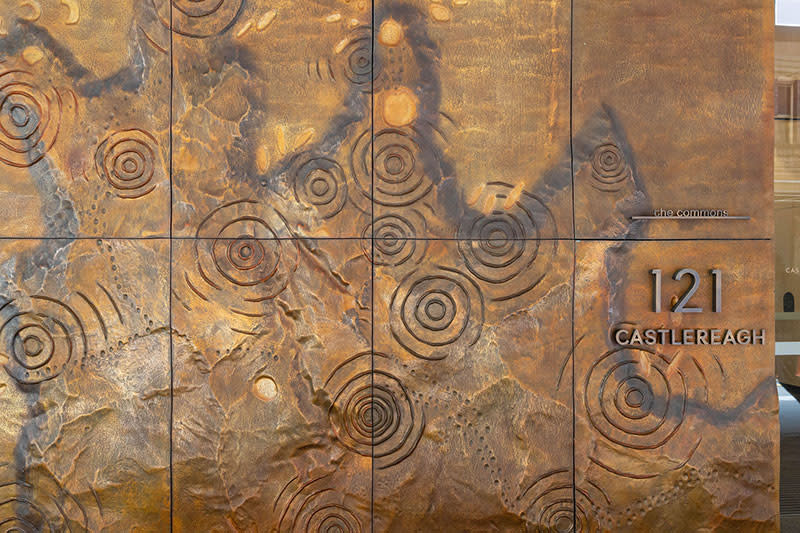
On the corner of Castlereagh and Market streets, on the old David Jones site, Dharawal and Yuin artist Alison Page has made Dreaming of the Ancestors: five works threaded through the mixed-use development Cbus Property and Scentre Group have built there, designed by fjc studio.
Take the works out and you still have a fine heritage building in the centre of the city.
Leave them in and you have a place that knows whose Country it stands on. Ngura (‘home’ in Dharawal) is a cast bronze wall that reads as a map, its coastline shifting as you move past it.
Woven bronze baskets hang above, tracing journeys across land and water. At the residential entry, a cluster of works called Gurabangbulawala, (or ‘stones’), glow as guiding lights so residents can find their way home.
The brief asked for public art. What the site received was a way of belonging to it.
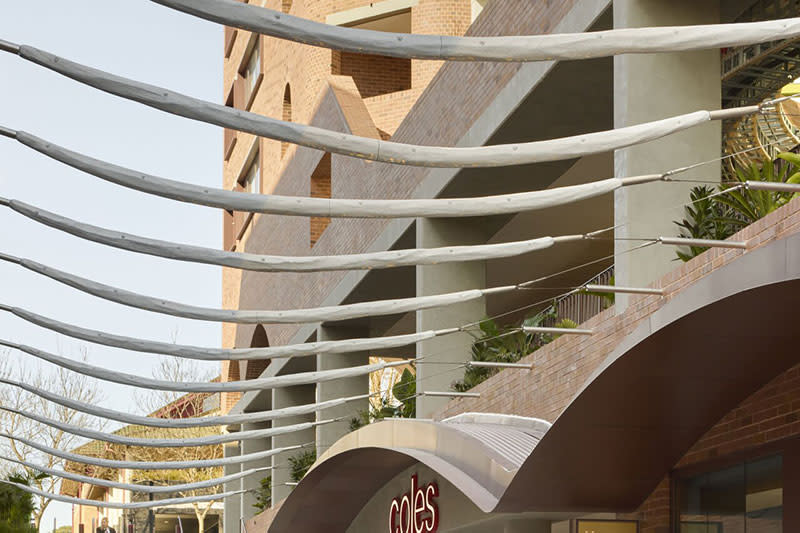
A short walk south, at Wunderlich Lane at Surry Hills Village, Jacob Nash’s Lines on Country [pictured at top and above] works the same effect.
Commissioned by TOGA, with architecture by SJB and landscape by Aspect Studios, it occupies the air and the ground at once: 20 sculptural forms suspended on a catenary over the laneway, cast in aluminium and lit after dark, with inlays set into the pavement below.
The ground and the sky start talking to each other, carrying First Nations knowledge through a place thousands of people move through without ever being lectured about it.
It belongs so completely that most will assume it was always meant to be there. That is exactly the point.
Neither of these works had to be this good. The planning condition could have been satisfied by something smaller or simpler to integrate.
What made the difference was not compliance. It was conviction, shared by everyone involved.
It took a developer prepared to amend the base build so the art could be held properly rather than bolted on at the end. An architect who eagerly collaborated and championed the artist’s vision. Cultural advisors and language custodians who kept the works honest. And artists trusted with a brief that had something real to answer.
UAP sat at the centre of all of it, shaping the strategy, curating the artists and delivering the works. But the result belonged to everyone around the table who treated the requirement as a starting point rather than a box to close.
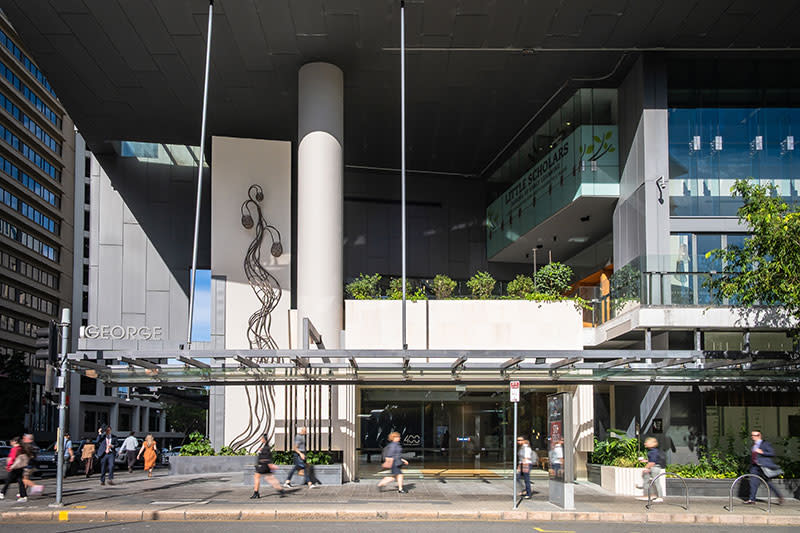
These two works happen to be in Sydney, but the principle extends well beyond any one city.
In Brisbane, at the entrance to 400 George Street, Ngugi Quandamooka artist Sonja Carmichael’s Talwalpin durenma dutta climbs more than 10m through the lobby: bronze vines modelled on the native cotton tree, woven dilly bags cast from forms she first made by hand, and brass leaves inlaid across the floor.
Commissioned by Cromwell Property Group as part of a lobby revitalisation, it carries Quandamooka weaving practice into the centre of the city.
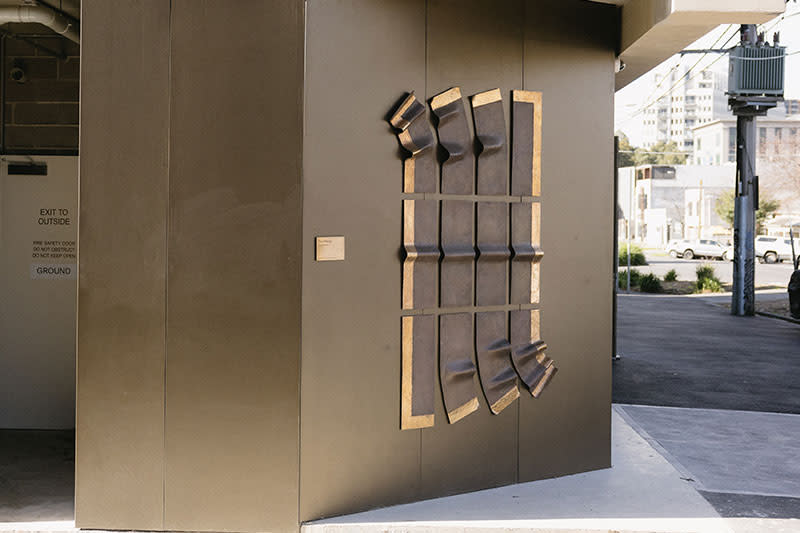
In Melbourne, the same instinct runs through works like Ben Mazey’s Bronze Flag Carpet in South Melbourne, where 12 cast bronze panels turn a building’s facade into a place to gather.
Different cities and different artists, but the same conditions: early integration, genuine collaboration and a willingness to treat art as part of the project rather than an obligation added at the end.
Public art pays its way in foot traffic, dwell time, the pull a strong work gives a precinct and the value it holds over the years.
But the numbers are the proof, not the reason.
The commissions that come to define a place are made on conviction, before any of that is certain, by people who stood on the site and knew something would be missing without the work.
That absence is the real measure. You cannot always reduce it to a figure, but you can feel it standing in the space, and so can everyone who comes after you. It is why people take the long way through a lobby, photograph a laneway, tell a friend to go and look.
Art is one layer among many that make a place, but often the one that makes it worth returning to.
So, the question I would put to any developer is not whether public art earns its place in the budget.
It is the one at the top of this page.
Picture your finished project, take the art out and ask what is left. If the honest answer is “a very good building”, you have met the requirement.
If it is “it would not be the same place”, you have built something worth building.
The best clients we work with already know the difference. They do not ask what the art must be. They ask what their place would be without it.
The Urban Developer is proud to partner with Urban Art Projects (UAP) to deliver this article to you. In doing so, we can continue to publish our daily news, information, insights and opinion to you, our valued readers.
Explore more: Brisbane, Commercial, Design & Architecture, Melbourne, Placemaking, Social & Community, Sydney