
IndustryLindsay SaundersFri 31 Jul 26
Australia’s Industrial Vacancy Falls as Demand Stays Strong

Australia’s industrial and logistics market tightened further through the second quarter of 2026 as slowing new supply and resilient occupier demand pushed the national vacancy rate below 5 per cent.
According to new research from JLL, the national vacancy rate fell from 5 per cent to 4.8 per cent during the quarter, while the sublease market remained steady at 0.7 per cent. Direct vacancy also tightened from 4.3 per cent to 4.1 per cent, reflecting continued strength in the underlying occupier market.
JLL head of strategic research Annabel McFarlane said tenant activity was being shaped by a wave of lease expiries from deals struck during the tight market conditions of 2021.
“Many occupiers committed to five-year lease terms in 2021 are now reassessing their operational needs in a more balanced market,” she said.
Brisbane again led the country, recording 308,200sq m of net absorption during the quarter and 549,400sq m year-to-date.
Vacancy tightened sharply from 5.3 per cent to 4.5 per cent as population growth, faster development timeframes and the first industrial demand linked to preparations for the Brisbane 2032 Olympic and Paralympic Games flowed through the market.
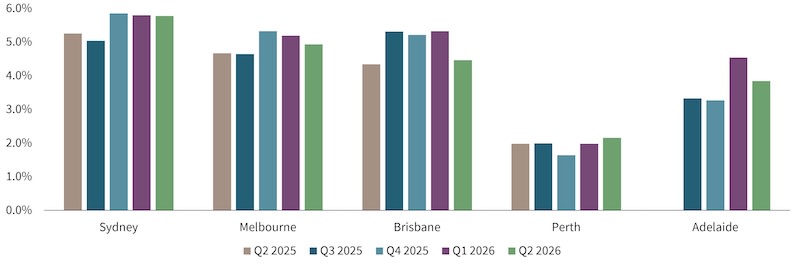
Melbourne posted its third consecutive quarter in which tenant transactions exceeded twice the historical average, with occupier moves larger than 5000sq m totalling 443,100 square metres.
Vacancy also compressed from 5.2 per cent to 4.9 per cent, although JLL said demand remained uneven across precincts and supply of larger warehouses was becoming constrained.
Sydney’s vacancy rate stabilised despite new multistorey logistics developments reaching completion during the quarter.
JLL said most new super-prime industrial space had already been absorbed, with manufacturing emerging as the largest occupier group nationally, accounting for 37 per cent of take-up.
Supporting services for the data centre construction boom also became an increasingly important source of demand in Sydney, representing 14.5 per cent of gross take-up during the quarter.
Adelaide continued to outperform, with vacancy tightening from 4.5 per cent to 3.8 per cent after 160,700sq m of net absorption, while Perth’s vacancy edged up slightly to 2.2 per cent despite recording positive demand.





